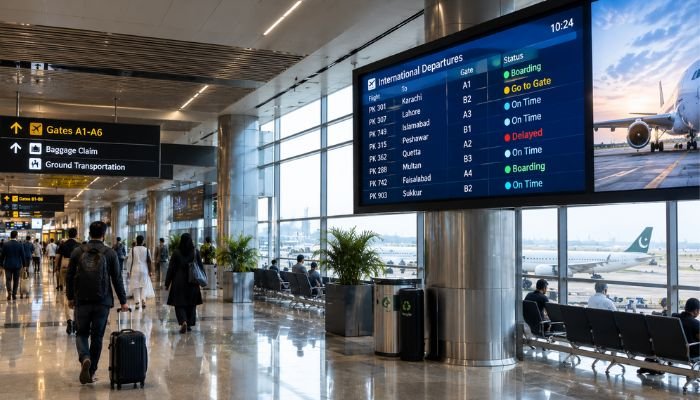
SMD Screens for Airports in Pakistan: Digital Display Solutions for Passenger Information
| TL;DR — Quick Answer SMD Screens are used across Pakistani airports to display real-time flight information, gate changes, baggage claim updates, wayfinding, security notices, and retail or advertising content. Compared to older LCD-based flight information boards, SMD Screens offer seamless large-format viewing, higher brightness for terminals with heavy natural daylight, and continuous 24/7 reliability with minimal downtime. Airport installations typically use a fine pixel pitch of P1.8 to P2.5 for close-viewing counters and check-in areas, and a coarser pitch such as P3 to P4 for large overhead departure and arrival boards viewed from a distance. Smart One Power Solution designs SMD Screens for airport and institutional environments with redundant power backup, content management integration, and round-the-clock support. |
Walk through any modern airport terminal and digital displays are doing far more work than most passengers ever notice — guiding them to the right gate, flashing baggage carousel numbers, warning of delays, and quietly running advertising loops between flights. Pakistan’s airports are steadily modernising this passenger experience, and SMD Screens have become the display technology of choice for doing it reliably, around the clock, in some of the busiest and most demanding public environments in the country. This article looks at exactly how SMD Screens are used across airport terminals, what makes them a better fit than older display technologies, and what an airport authority or private terminal operator should look for before installing one — based on real institutional and large-format deployment experience from Smart One Power Solution.
Why Airports Are Moving to SMD Screens
Airports operate on a schedule that never really stops, and the information passengers need changes by the minute — a gate assignment shifts, a flight is delayed, a carousel number updates. Static printed signage simply can’t keep up with that pace, and older LCD-based flight information displays struggle with two specific airport challenges: seamless large-format coverage and reliable 24/7 operation under constant, heavy use. SMD Screens solve both problems directly, offering bezel-less, continuous image coverage across large departure boards and video walls, along with the industrial-grade durability needed to run non-stop, year-round, without the panel degradation that consumer-grade displays experience under that kind of load.
Where SMD Screens Are Used Inside an Airport Terminal
Flight Information Display Systems (FIDS)
The most visible use of SMD Screens in any airport is the flight information display system — the large overhead boards showing departure times, gate numbers, delays, and boarding status. These typically run on a coarser pixel pitch suited to being read from a distance across a crowded terminal hall, updated in real time through the airport’s central information system.
Baggage Claim and Arrival Screens
Carousel assignments and arrival status updates displayed near baggage claim areas help reduce passenger congestion and confusion, particularly during peak arrival periods when multiple flights land close together.
Wayfinding and Terminal Navigation
Digital wayfinding screens guide passengers to gates, immigration counters, lounges, and amenities, often combining static directional information with dynamic, time-sensitive updates that a printed sign simply cannot provide.
Check-in Counters and Immigration Areas
Closer-viewing SMD Screens at check-in counters and immigration desks display queue information, counter numbers, and processing status, usually built on a finer pixel pitch since passengers stand much closer to these displays than to overhead boards.
Security and Emergency Notices
Terminal-wide SMD Screens are also used to broadcast urgent security announcements, weather advisories, or emergency instructions instantly across every screen in the building — something static signage and printed notices cannot achieve in the moments when timing matters most.
Retail, Lounge, and Advertising Displays
Beyond operational information, airports increasingly use SMD Screens for retail promotions, airline branding, and paid advertising near boarding gates, duty-free areas, and lounges, turning idle waiting time into a revenue-generating opportunity for the terminal operator.
SMD Screens vs Traditional LCD Flight Information Boards
| Factor | SMD Screens | Traditional LCD Boards |
| Large-format coverage | Seamless, bezel-less, modular | Visible bezels between units |
| Brightness in daylight terminals | High-nit panels stay legible near glass facades | Often struggles under strong natural light |
| 24/7 reliability | Built for continuous industrial-grade use | Consumer-grade panels wear faster under constant use |
| Maintenance | Modular cabinets, section-by-section repair | Often requires full-unit replacement |
| Content flexibility | Runs FIDS data, video, and ads on one system | Limited mostly to data-only, low-graphic display |
Choosing the Right Pixel Pitch for Airport Displays
Not every screen inside a terminal needs the same specification. Large overhead departure boards viewed from across a hall typically use a P3 to P4 pixel pitch, since viewers are rarely closer than several metres away, while check-in counters, immigration desks, and gate-side information panels benefit from a finer P1.8 to P2.5 pitch for close-range clarity. Our detailed comparison in How to Choose SMD Screen Brightness for Indoor and Outdoor Environments and the pixel-pitch breakdown in our P2.5 SMD Screen guide are useful starting points when specifying displays for different zones within the same terminal.
Key Technical Requirements for Airport-Grade SMD Screens
- Redundant power backup: Airport displays cannot go dark during an outage, so UPS and backup generator integration is essential, sized against the panel’s maximum draw.
- Centralised content management: A single control system should be able to push updates to FIDS boards, wayfinding screens, and gate displays simultaneously and instantly.
- High brightness for glass-heavy terminals: Many modern terminals feature large glass facades that flood the space with daylight, requiring panels rated well above typical indoor brightness levels.
- 24/7 duty-cycle components: Power supplies and LED modules rated for continuous operation, not intermittent commercial use, extend the reliable lifespan of the installation.
- Fail-safe redundancy: Critical information displays benefit from backup signal paths so a single processor or cable fault doesn’t take an entire board offline.
- Integration with airport IT systems: FIDS data typically needs to sync directly with airline scheduling and air traffic systems, so compatibility with existing airport software is a must at the planning stage.
Why Government and Institutional Projects Trust Smart One Power Solution
With 15 years of experience in power systems and display technology, Smart One Power Solution has delivered large-scale SMD Screens and video wall installations for government, defence, and institutional clients across Pakistan — the same category of high-reliability, high-security environment that an airport terminal represents.
This includes the Indoor SMD Video Wall installation at NAB Islamabad, built for a government briefing environment where uptime and image clarity were non-negotiable, and the Digital Indoor SMD Screen at Faisal Base Karachi, a military-grade deployment demonstrating the same reliability standards airport authorities require from a passenger information system. That combination of institutional experience and power-systems expertise is what positions Smart One Power Solution to support airport terminal operators planning a digital display upgrade.
Planning an Airport SMD Screen Rollout: Key Considerations
- Zone-by-zone specification: Departure halls, check-in areas, gates, and baggage claim each have different viewing distances and lighting conditions, and should be specified individually rather than with a single generic panel.
- Phased installation: Terminal operations rarely allow a full shutdown, so installations are often planned in phases around live passenger traffic and flight schedules.
- Long-term maintenance contracts: Given the 24/7 nature of airport operations, a service agreement with guaranteed response times matters as much as the initial installation quality.
- Future scalability: Terminal expansions and new gate additions should be considered at the design stage so the display network can grow without a complete system overhaul.
The Passenger Experience Impact of Well-Planned SMD Screens
Beyond the technical specification sheet, the real measure of a successful airport display network is how it changes the way passengers move through a terminal. Clear, consistently updated flight information reduces the crowd of people hovering anxiously near a single information desk. Well-placed wayfinding screens cut down on missed connections caused by confusion over gate locations. Even the advertising and retail content running on SMD Screens near boarding lounges serves a secondary purpose beyond revenue — it fills otherwise idle waiting time and contributes to a terminal that feels modern and well managed rather than chaotic. Airport authorities evaluating a digital signage investment increasingly weigh this passenger-experience impact alongside the more obvious operational and advertising benefits.
Energy and Backup Power Planning for Airport-Scale Installations
A terminal-wide network of SMD Screens represents a meaningful, continuous electrical load, running 24 hours a day across dozens or even hundreds of individual panels. Because flight information cannot simply go dark during a power interruption, airport-grade installations need properly sized UPS systems and generator backup, calculated against peak brightness draw rather than average consumption. Our detailed breakdown in SMD Screen Power Consumption Explained covers exactly how that calculation works, and it becomes even more critical at airport scale, where a display outage isn’t just a visual inconvenience — it can directly disrupt passenger flow and flight operations.
The Role of Content Design in Airport SMD Screen Networks
Even the best-specified SMD Screens underperform if the content running on them isn’t designed for the environment. Flight information data needs high contrast and legible typography sized correctly for its typical viewing distance, while advertising or branding content should be paced to fit the short attention spans of passengers walking past rather than sitting to watch. Airports that treat content design as part of the display project — rather than an afterthought handled separately — tend to see a noticeably better return on the investment, both in passenger satisfaction and in advertising revenue from retail and airline partners.
Frequently Asked Questions
Why do airports use SMD Screens instead of regular LCD monitors?
SMD Screens offer seamless large-format coverage without visible bezels, higher brightness for daylight-heavy terminals, and industrial-grade durability built for continuous 24/7 operation, all of which regular commercial-grade LCD monitors struggle to match at airport scale.
What pixel pitch is best for airport flight information boards?
Large overhead departure and arrival boards typically use a P3 to P4 pixel pitch for distance viewing, while closer-range displays at check-in counters and gates often use a finer P1.8 to P2.5 pitch for sharper close-up clarity.
Can SMD Screens integrate with an airport’s existing flight information system?
Yes. Airport-grade SMD Screen installations are typically paired with a content management and video processing system capable of pulling live data feeds from the airport’s flight information and scheduling software.
How reliable are SMD Screens for round-the-clock airport use?
With proper component selection, redundant power backup, and regular maintenance, SMD Screens are built to handle continuous operation, making them well suited to environments like airports that never fully shut down.
Do airport SMD Screens need special brightness levels?
Yes, especially in terminals with large glass facades, where daylight can be intense. These areas typically need brighter panels than a standard indoor commercial display to remain clearly legible throughout the day.
Final Thoughts
As Pakistan’s airports continue modernising the passenger journey, SMD Screens have become the practical backbone of that transformation — handling everything from flight updates and wayfinding to emergency alerts and retail advertising on a single, reliable display network. Getting the pixel pitch, brightness, redundancy, and system integration right at the planning stage is what separates a terminal display network that runs smoothly for years from one that becomes a recurring maintenance burden.
| Planning a digital display upgrade for an airport or institutional facility? Smart One Power Solution provides end-to-end SMD Screens, video walls, and power-backup planning for airports, government buildings, and large institutional facilities across Pakistan. |