Transparent LED Glass Displays for Retail Showrooms & Commercial Windows in Pakistan: Complete Architectural Guide
| TL;DR: Quick Answer A transparent LED display screen in Pakistan is a see-through LED panel mounted behind or inside shop glass. It delivers 70%+ light transmission, so natural light still enters, while 5,000+ nits of brightness keep content vivid in daylight. Retailers use it to turn ordinary windows into luxury, animated storefronts without blocking the view of products inside the store. |
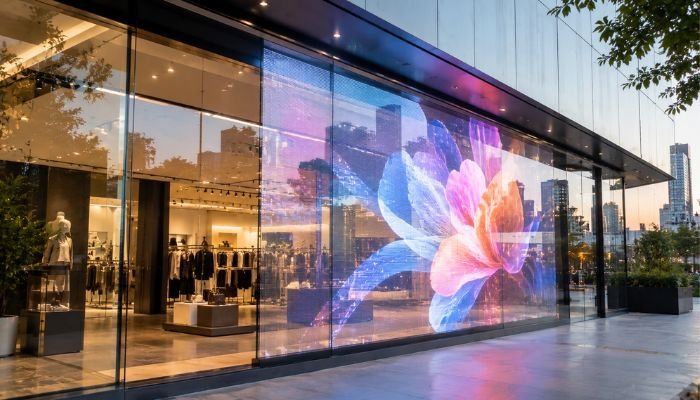
Walk down MM Alam Road in Lahore or Zamzama in Karachi at noon, and you will notice a pattern. The storefronts that stop people are rarely the ones with the biggest signboards. They are the ones where the glass itself seems alive, with a product reveal or a sale animation floating in front of the mannequins and merchandise behind it.
That effect comes from transparent LED glass displays, and in Pakistan’s competitive retail market they are moving from a novelty to a serious architectural tool. This guide covers how the technology works, how to integrate it into real facades, and how to choose the right pixel pitch for your space.
What Is a Transparent LED Display?
A conventional LED video wall is a solid cabinet packed with diodes. A transparent LED screen is built differently. The LEDs sit on slim, near-invisible strips or a mesh-like grid, leaving open gaps between them. Light and sightlines pass through those gaps, while the LEDs themselves produce a bright image.
The result is a screen that behaves like a layer of light on your window. Shoppers outside see animated content. Staff and customers inside still see the street. When the display is off, the panel reads as clear glass.
Compared with window vinyl, projection film, or an LCD behind the glass, transparent LED has clear advantages:
- It stays visible in sunlight. Projection film struggles in daylight, and LCDs mounted at windows wash out. Transparent LED panels are built to reach 5,000+ nits.
- It keeps the window functional. You do not trade your display space for signage space. Merchandise stays visible.
- It looks premium. The floating-image effect suits fashion, jewellery, electronics, automotive, and luxury retail.
Why Pakistani Retailers Are Adopting Glass LED Screens
Pakistan’s retail landscape has changed quickly. Mall developments, branded showrooms, and high-street boutiques all compete for the same few seconds of attention. A glass LED screen in Lahore or a transparent video wall in Karachi gives a brand three things at once.
Motion in a high-footfall setting. Animated content pulls the eye far more reliably than static banners, especially during evening shopping hours when foot traffic peaks.
Flexible campaigns. Eid sales, wedding season collections, Ramadan offers, and new arrivals can be swapped in minutes by updating a file, with no reprinting and no installers on a ladder.
A modern brand signal. For international franchises and ambitious local labels, the storefront is the first impression. A seamless digital window signals confidence in a way a lit box sign cannot.
Architectural Integration: Installing Behind Structural Glass Facades
The biggest question architects and shop owners ask is practical: how does this sit on or behind real glass, and does it cut off daylight?
Installation Approaches
Behind the glass (most common). Panels are fixed on the inside face of the glass, typically using a lightweight aluminium frame, adhesive mounting, or suspended rails from the ceiling. This protects the screen from dust, rain, and tampering, and it keeps the facade’s exterior clean.
Hanging inside the window bay. In showrooms with deep windows, the display hangs a short distance behind the glass. This creates a layered depth effect, with the animation floating between the street and the products.
Integrated into curtain wall systems. For new construction, panels can be coordinated with the facade design from the start, with cable routing and ventilation planned in advance.
Protecting Natural Light and Views
Because transparent LED panels let 70% or more of light pass through (depending on pitch), the interior stays bright. Your merchandise remains lit by daylight, your staff keep an outward view, and your air conditioning load is not worsened by blocking natural light and compensating with extra internal lighting.
Practical Considerations for Pakistan
Local conditions matter, and a good installer plans for them:
- Summer temperatures in Lahore and Karachi are demanding. Panels sitting behind sun-exposed glass need adequate ventilation and thermal design. Ask about operating temperature range.
- Dust and humidity. Karachi’s coastal air and Lahore’s dust call for sealed connectors and protective coatings. Indoor-side mounting greatly reduces exposure.
- Power stability. Voltage fluctuation is a real issue. Surge protection and a proper power distribution setup protect your investment.
- Glass load and structure. Panels are lightweight, but the mounting system should rely on the building’s structure, not just the glass. A site survey confirms this.
Choosing the Right Transparent Pitch
Pixel pitch is the distance between the centres of two adjacent LEDs, measured in millimetres. A smaller pitch means more pixels per square metre and a sharper image, but typically lower transparency and a higher cost. A larger pitch lets more light through and costs less, but looks best from a distance.
The right choice depends mostly on viewing distance. Standing a metre from a window needs a very different pitch than viewing it from across a road.
| Pixel Pitch | Typical Transparency* | Best Viewing Distance | Ideal Use Case |
| P3.91-7.81 | Approx. 60-70% | 4-8 m and up | Boutiques, jewellery stores, mall shopfronts, and showrooms where shoppers view the glass close up and image detail matters |
| P7.82 | Approx. 70-75% | 8-15 m | Standard retail windows, car showrooms, electronics stores, and banks facing a footpath or forecourt |
| P10.42 | Approx. 75-80%+ | 12 m and up | Large facades, atriums, and glass towers where maximum transparency matters more than fine detail |
*Transparency figures vary by manufacturer and panel design. Treat these as typical ranges and confirm exact specifications for your chosen model.
How to Read the Matrix
If your window faces a busy footpath where people walk within a few metres, lean toward the finer P3.91-7.81 range so logos and typography look crisp. If your showroom faces a road and customers see it from a car or from across the street, P7.82 or P10.42 gives you better transparency at a sensible budget, and the image still reads clearly at that distance.
A good rule of thumb: the detail you need in the image should drive pitch, and the distance of your audience should confirm it.
Content Design Tips for Transparent Screens
Hardware is only half the result. Content built for a see-through display behaves differently from content built for a normal screen.
Use dark backgrounds sparingly. On transparent LED, black means “no light,” which means transparent. Bright, high-contrast graphics on a black background show up as floating elements. Large solid colour blocks can look heavy.
Keep text large and short. One clear message per scene works best. Think brand name, offer, call to action.
Design with the store behind it. Leave space so your product, mannequin, or interior lighting remains part of the composition rather than clashing with the animation.
Plan for day and night. At night the display looks dramatic and glowing. In daylight, high brightness carries it, but bolder, simpler graphics read better than delicate gradients.
Where Transparent LED Delivers the Best Return
Not every business needs one, but several categories benefit strongly:
- Fashion and luxury retail, where the window is the main marketing channel
- Car showrooms, where large glass frontages are standard
- Mobile and electronics stores, which depend on dynamic product launches
- Restaurants and cafes, for menu highlights and promotions at the entrance
- Banks and corporate lobbies, for brand presence without sacrificing openness
- Real estate and exhibition spaces, for glass-fronted sales offices
Planning Your Project: A Simple Roadmap
- Define the goal. Brand image, promotions, or both? This guides content and screen size.
- Measure the glass. Panels come in modular sizes, so accurate dimensions let you cover the window cleanly.
- Choose your pitch. Use the matrix above, matched to real viewing distance.
- Request a site survey. Check structure, power, ventilation, and sun exposure before you commit.
- Prepare your content. Brief a designer on the transparent format early, not after installation.
- Install and calibrate. Brightness should be tuned to the time of day, which also saves energy.
Choosing the Right Partner in Pakistan
Transparent LED is a precision product. Poor installation shows quickly as visible frames, uneven brightness, or heat problems. When comparing suppliers, ask about warranty terms, spare part availability, local technical support, and examples of completed installations. A supplier who offers a site survey and a visual mockup of the display on your actual window is showing confidence in their work.
You can explore specifications and available options on our Transparent LED Display page, or learn more about our wider range of display solutions from the SOPS home page.
Frequently Asked Questions
Does a transparent LED screen block the view from inside?
No. With 70%+ transparency on suitable pitches, people inside can see out clearly, though a faint dot pattern may be noticeable up close.
Can it be seen in direct sunlight?
Yes. Panels rated at 5,000+ nits are designed for bright daylight environments, which is why they suit sun-facing storefronts.
Is it suitable for both Lahore and Karachi climates?
Yes, provided the installation accounts for heat, humidity, and dust through proper ventilation and indoor-side mounting.
Can I update content remotely?
Most systems support network-based content management, so you can schedule campaigns from a laptop or phone.
Ready to See It on Your Own Window?
The easiest way to judge a transparent LED screen is to see it on your own storefront. Our team can prepare transparent glass mockups of your window and arrange a custom site survey so you know the exact pitch, size, and installation method before you commit.
Call or WhatsApp: +92 308 4666059
Or send us your window dimensions through our Contact Us page.
Turn your glass into your best salesperson.