SMD Screen Power Consumption & Solar Inverter Integration in Pakistan: Managing Load Shedding
| TL;DR Standard outdoor SMD LED screens in Pakistan consume between 250W to 450W per square meter on average, with peak surges reaching 800W/sqm under direct sunlight. To ensure uninterrupted operation during grid load shedding, pairing displays with pure sine wave hybrid solar inverters and industrial surge protection prevents module burnouts and stabilizes operational costs. |
Load shedding is the quiet enemy of every digital signage investment in Pakistan. A screen that goes dark at noon wastes paid advertising time, and repeated hard shutdowns and voltage spikes shorten the life of power supplies and LED modules. Meanwhile, the monthly bill for a large display surprises owners who never calculated the load. This guide gives you the formulas to size power, backup, and protection correctly.
How an SMD Screen Draws Power
An SMD screen does not use a fixed wattage. Brightness matters most, because outdoor screens run near full output in sunlight. Content matters too: white lights every diode in a pixel, while black lights none. Heat adds fan and cooling load. Datasheets therefore quote maximum power, with every pixel at full white, and average power, with typical content at normal brightness. Use maximum to size electrical equipment, and average to estimate running cost and battery capacity.
Technical Calculation Matrix
1. Average vs Peak Wattage
This table shows typical outdoor SMD screen wattage and indoor figures, per square metre, per module, and per cabinet.
| Display Type | Average (W/sqm) | Peak (W/sqm) | Per 320×160 mm module (avg / peak) | Per 960×960 mm cabinet (avg / peak) |
| Outdoor SMD (P6-P10) | 250-450 | 800 | 13-23 W / 41 W | 230-415 W / 740 W |
| Indoor SMD (P2.5) | 150-250 | 450-600 | 8-13 W / 23-31 W | 138-230 W / 415-553 W |
Typical values; confirm against your cabinet datasheet. With auto-brightness, night consumption on outdoor screens usually falls below 150 W/sqm.
2. Inverter or Generator kVA by Screen Area
Size equipment from peak load, not average. LED power supplies also create a brief inrush current at start-up, so add a margin:
Required kVA = (area in sqm × 800 W ÷ 0.9 power factor) × 1.25 ÷ 1,000
In square feet, peak load is roughly 75 W per sq ft. Here is the result for common sizes:
| Area (sqm) | Area (sq ft) | Peak load | Minimum kVA | Practical inverter / generator |
| 5 | 54 | 4.0 kW | 5.6 kVA | 6 kVA |
| 10 | 108 | 8.0 kW | 11.1 kVA | 12 kVA |
| 20 | 215 | 16.0 kW | 22.2 kVA | 25 kVA |
| 40 | 431 | 32.0 kW | 44.4 kVA | 50 kVA |
Generators need the same figure, plus extra if they also charge batteries. Size them at least 25% above the inverter rating.
3. Battery Ampere-Hour Sizing
Battery Ah = (average load W × backup hours) ÷ (battery voltage × depth of discharge × inverter efficiency)
The table assumes 4 hours of backup, a 350 W/sqm mid-range average, a 48 V bank, and 95% inverter efficiency.
| Area (sqm) | Average load (350 W/sqm) | Energy for 4 h | LiFePO4 at 48 V (90% DoD) | Lead-acid at 48 V (50% DoD) |
| 5 | 1,750 W | 7.0 kWh | 171 Ah | 307 Ah |
| 10 | 3,500 W | 14.0 kWh | 341 Ah | 614 Ah |
| 20 | 7,000 W | 28.0 kWh | 682 Ah | 1,228 Ah |
Lithium (LiFePO4) allows deeper discharge, so it needs roughly half the Ah of lead-acid and tolerates Pakistan’s heat better.
4. Voltage Fluctuation Protection
Pakistan’s grid brings spikes, sags, and sudden drops, and surge damage is among the most common causes of failed screens. Layer your protection:
| Protection Layer | Device | What It Does |
| Surge | Type 2 SPD at the main board and near the screen | Diverts spikes from the grid and generator before they reach power supplies |
| Over/under voltage | Voltage protection relay | Disconnects the screen outside a safe window (many LED supplies tolerate roughly 176-264 V; check your datasheet) |
| Regulation | Servo stabiliser or wide-input hybrid inverter | Holds output steady through brownouts and swings |
| Earthing | Dedicated earth pit, below about 5 ohms | Gives surges a safe path; re-test after monsoon |
| Start-up | Sequential power controller | Staggers cabinet switch-on to tame inrush current |
Pakistan’s heat also deserves a margin. Cabinets, inverters, and lithium batteries all lose efficiency in high temperatures, so mount inverters in shaded, ventilated rooms, keep rear service space clear behind cabinets, and never place battery banks in direct sun or sealed enclosures.
Solar Array and Your Electricity Bill
Lahore averages roughly five peak sun hours daily, which makes solar practical. For a 10 sqm outdoor screen drawing 3.5 kW by day for 10 hours and 1.2 kW at night for 6 hours, daily energy is 35 + 7.2 = 42.2 kWh. Then:
Array (kW) = daily kWh ÷ (peak sun hours × 0.75) = 42.2 ÷ (5 × 0.75) ≈ 11.3 kW
Most owners install a smaller array and let the grid cover the rest. To estimate your commercial LED screen electricity bill in Pakistan, multiply monthly kWh by your tariff. At an illustrative Rs 60 per unit, 42.2 kWh a day (about 1,266 kWh a month) costs roughly Rs 76,000. Check your current tariff, because rates and slabs change.
A Complete Load Shedding Solution
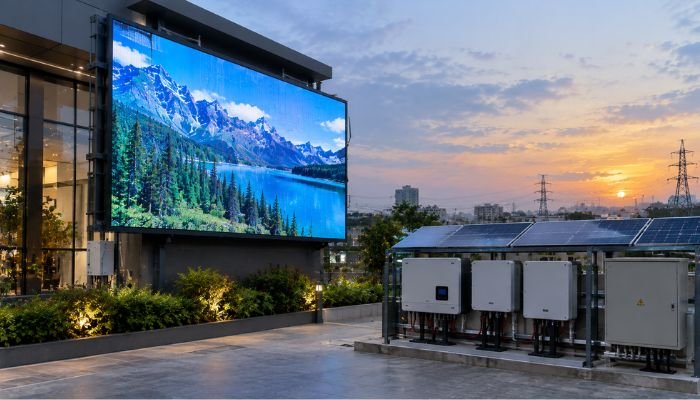
A reliable load shedding SMD screen solution combines four parts: a pure sine wave hybrid inverter, correctly sized batteries, the protection layers above, and a safe generator changeover. Modified sine wave inverters can overheat LED power supplies, so avoid them. Choose a hybrid unit with fast transfer time so the screen never reboots.
Plan in this order: list every device (screen, controller, media player, cooling), calculate peak and average load, choose your backup hours, then size the inverter, batteries, and panels. Monitor real consumption for the first month and adjust.
Generator connection must go through an automatic transfer switch, never improvised wiring. Key safety points:
- Prevent backfeed. Grid and generator must never energise the same circuit together.
- Confirm phase sequence on three-phase systems before commissioning.
- Add a start delay, so the screen only loads once voltage and frequency are stable.
- Use qualified electricians. A faulty changeover is a fire and electrocution hazard.
Cutting Consumption Without Cutting Impact
- Enable auto-brightness. A light sensor can cut night output by 40% or more.
- Design darker content. Black backgrounds with bright text use far less power than full-white scenes.
- Schedule operating hours. Switch the screen off when no audience is present.
- Keep cabinets clean and shaded. Lower heat means less fan load and longer LED life.
Choosing the Right Partner
Ask any supplier for real average and peak figures, not one headline number, and for advice on inverter and battery integration. A SOPS power backup display design covers the screen, inverter, batteries, and protection as one system. Explore the SOPS home page or compare models under Our Products.
Frequently Asked Questions
How much power does an outdoor SMD screen use per square metre?
An outdoor SMD screen typically uses 250W to 450W per square metre on average, with peaks near 800W per square metre under direct sunlight at full brightness. Night consumption is usually below 150W per square metre with auto-brightness enabled.
What size solar inverter do I need for an SMD screen?
Multiply the screen area by 800W to get peak load, divide by a power factor of 0.9, then add 25% for inrush current. A 10 sqm outdoor screen needs about 11.1 kVA, so a 12 kVA pure sine wave hybrid inverter is the practical choice.
Can I run an SMD screen on a generator during load shedding?
Yes, through an automatic transfer switch that prevents grid backfeed and waits for stable voltage and frequency. Size the generator at least 25% above the inverter rating if it also charges the battery bank.
How do I calculate battery capacity for an LED display?
Battery Ah equals average load in watts multiplied by backup hours, divided by battery voltage, depth of discharge, and inverter efficiency. A 10 sqm screen backed up for 4 hours needs about 341Ah of LiFePO4 at 48V.
How do I protect an SMD screen from voltage fluctuations?
Use surge protection devices at the main board and near the screen, a voltage protection relay, a stabiliser or wide-input hybrid inverter, a low-resistance earth, and sequential power-on. Together these prevent module and power supply burnouts.
Get a Free Solar Display Power Audit
Guessing your load leads to oversized bills or undersized systems. We offer a free solar display power audit and a custom quotation based on your screen’s real consumption.
Call or WhatsApp: +92 308 4666059
Or send your screen size and location through our Contact Us page.
Keep your screen lit, and keep your costs under control.