Curved & Flexible SMD LED Screens in Pakistan: Architectural Columns & Concave/Convex Display Guide
| TL;DR Curved and flexible SMD LED screens in Pakistan utilize soft silicone rubber PCB modules capable of bending into concave, convex, and 360-degree cylindrical column shapes without distorting pixel pitch. Engineered by Smart One Power Solutions (SOPS) for flagship retail showrooms, corporate atriums, and studios, they deliver seamless wraparound visuals with 3840Hz refresh rates. |
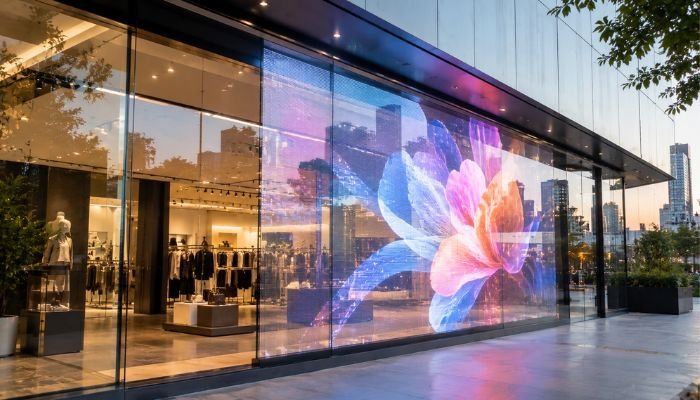
Straight rectangles are no longer the only shape a screen can take. Flagship stores wrap pillars in moving brand imagery, atriums curve displays around staircases, and studios build immersive backdrops from concave walls. In Pakistan, interest in curved SMD screens is rising as retailers and corporate clients look for architecture that doubles as a display. This guide explains how flexible modules work, how to plan concave, convex, and column installations, and what drives the price.
What Is a Flexible Soft-Module SMD Screen?
A flexible LED screen replaces rigid cabinets with soft modules built on a silicone rubber base, with the PCB and LEDs mounted so the module bends along one axis. Each module attaches to a curved frame or magnetic mounting plate, and the assembly follows the structure. Because the pixels sit on the surface rather than in angled boxes, the image stays continuous around the curve with no stepped seams.
One limit matters early: a soft module bends like a sheet of paper, along one direction. It can form a cylinder, a convex wall, or a concave arc, but not a sphere or a dome. Smart One Power Solutions (SOPS) specialises in architectural custom LED displays, fine-pitch P0.8 to P1.8 setups, and curved structural fabrication across Lahore, Karachi, and Islamabad, so shapes are checked against this limit before design begins.
Soft Modules vs Rigid Cabinets: Specs Comparison
| Specification | Soft Silicone Rubber Modules | Rigid Die-Cast Aluminium Cabinets |
| Module construction | Soft silicone rubber base with flexible PCB | Rigid die-cast aluminium cabinet |
| Available pitches | P1.8, P2, P2.5, P3 | Wide range, from P0.8 fine-pitch upward |
| Minimum bending radius | 150 mm to 300 mm for seamless curvature | Flat; gentle arcs only by angling cabinets, with visible stepping |
| Maintenance access | Front magnetic servicing using specialised vacuum tools | Front or rear, depending on cabinet design |
| Refresh rate and grayscale | 3840 Hz with 16-bit processing for anti-flicker broadcast | Often 3840 Hz or higher on fine-pitch models; confirm per model |
Figures are typical; confirm exact values on your model’s datasheet.
Refresh rate matters wherever cameras are involved. A 3840 Hz refresh rate with 16-bit processing keeps the screen free of flicker and banding on broadcast cameras and phones, which is why studios and flagship showrooms specify it.
Concave vs Convex: Viewing Angles
The direction of the curve changes how people experience the screen.
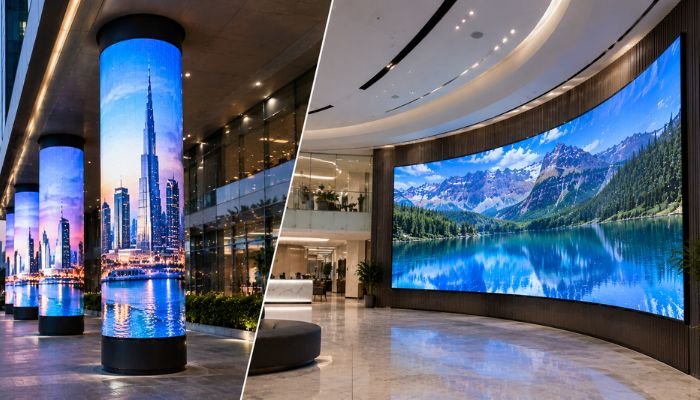
- Convex (curving outward): the image spreads across a wide arc, so passers-by see different parts of the content as they walk around. It suits columns, entrances, and feature walls. Design content so no key message sits on one face only.
- Concave (curving inward): the screen cups the viewer, giving an immersive, wraparound image to people near the focal point. It suits studios, experience zones, and showrooms. Sightlines converge, so plan the standing or seating area in that sweet spot.
On tight concave curves, viewers at the far edges see the opposite side of the screen at a steep angle, and colour can shift. Keep bright lights away from the curve as well, because concave surfaces can focus reflections. Choose pixel pitch from the closest viewing distance: the minimum comfortable distance in metres is roughly the pitch in millimetres, so P2.5 works from about 2.5 metres.
Cylinder Column Wraps: Sizing the Display
Columns are the most popular curved project in malls, hotels, and corporate lobbies. The maths is simple:
Modules around = circumference ÷ module width (typically 320 mm)
Pixels around = circumference ÷ pixel pitch
| Modules around (320 mm) | Circumference | Column diameter | Pixels around at P2.5 | Pixels around at P1.8 |
| 4 | 1,280 mm | about 407 mm | 512 | 711 |
| 6 | 1,920 mm | about 611 mm | 768 | 1,067 |
| 8 | 2,560 mm | about 815 mm | 1,024 | 1,422 |
The column radius must be at or above the module’s minimum bending radius. The 4-module column has a radius near 204 mm, which works only on models rated for that tightness. Real columns rarely match module multiples exactly, so a site survey fixes the final count, frame, and seam position.
Installation and Maintenance
- Curved sub-frame. A frame fabricated to the exact radius decides how smooth the image looks. A screen is only as straight as the structure behind it.
- Magnetic mounting. Modules attach magnetically and are serviced from the front with specialised vacuum tools, so a column against a wall needs no rear access.
- Service hatch. Plan a discreet hatch for power supplies and receiving cards, with ventilation, since columns are enclosed.
- Processing and content. The video processor must map the curved canvas, and content should be designed for the unwrapped surface and tested on site.
- Keep spare modules from the same batch, because colour can differ between production runs.
Flexible Soft Module Price Factors
Flexible displays usually cost more per square metre than flat rigid cabinets of the same pitch, because of the soft construction and custom frame. The main drivers are:
- Pixel pitch, since finer pitch means more LEDs per square metre
- Total surface area and curvature complexity
- Custom frame fabrication, cut-outs, and service hatches
- Processing, receiving cards, power, and ventilation
- Installation access, such as height, scaffolding, and working hours
- Spare module allowance, warranty, and content creation
Ask for a quotation that separates screen, structure, and installation, so you can compare suppliers fairly.
Where Curved Displays Work Best
- Flagship retail showrooms with pillar wraps and feature walls
- Corporate atriums and reception areas with curved brand backdrops
- Studios and broadcast sets using concave immersive walls
- Hotels, malls, and car showrooms wrapping columns and circular staircases
Wherever the screen is, keep content simple. Bold shapes, large type, and motion that flows around the curve read better than detailed layouts squeezed onto one face.
Planning Checklist
Start by measuring the structure: diameter or radius, height, and the distance to the closest standing point. Then choose the pitch, confirm the bending radius against the model, and decide where the seam and service hatch sit. Agree power, ventilation, and content format next. Finally, approve a visual mockup before fabrication begins, because changing a curved frame after it is built is expensive.
Choosing a Partner for Architectural LED
Curved projects fail when the screen and the structure are designed separately. Smart One Power Solutions (SOPS) handles display selection and curved structural fabrication together, with local support in Lahore, Karachi, and Islamabad. Explore the SOPS home page or compare models under Our Products.
Frequently Asked Questions
What is a flexible SMD LED screen?
A flexible SMD LED screen is built from soft silicone rubber modules with a flexible PCB, so it can bend into concave, convex, and cylindrical shapes while keeping the pixel pitch consistent across the curve.
What is the minimum bending radius of a flexible LED module?
Soft modules typically bend to a radius of 150mm to 300mm for seamless curvature. The exact limit depends on the pixel pitch and the model, so confirm it on the datasheet before designing a column.
Which pixel pitches are available for curved soft modules?
Soft modules are commonly available in P1.8, P2, P2.5, and P3. Choose the pitch from the closest viewing distance, since the minimum comfortable distance in metres is roughly the pitch in millimetres.
Can a flexible LED screen wrap a 360-degree column?
Yes, provided the column radius is at or above the module’s minimum bending radius. For example, six 320mm modules wrap a column of about 611mm in diameter, and a site survey confirms the exact module count.
What affects the price of flexible soft modules?
Price depends on pixel pitch, total surface area, curvature complexity, custom frame fabrication, processing and receiving cards, power and ventilation, installation access, and spare module allowance.
Get a Free Curved Display Site Survey
Every curve is different. We offer a free site survey and a custom curve design with visual mockup for your column, wall, or atrium before you commit.
Call or WhatsApp: +92 308 4666059
Or send your dimensions and photos through our Contact Us page.
Turn your architecture into your brightest display