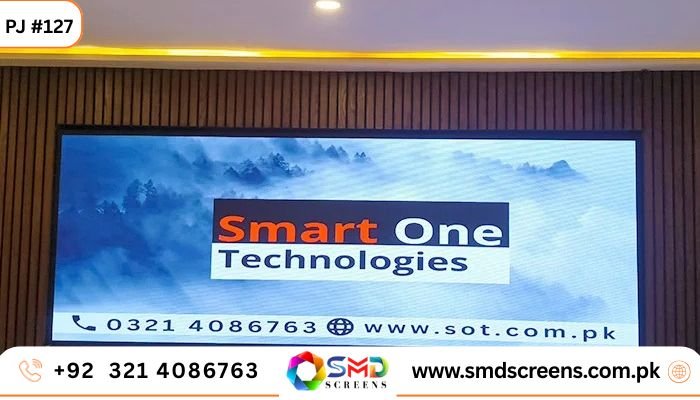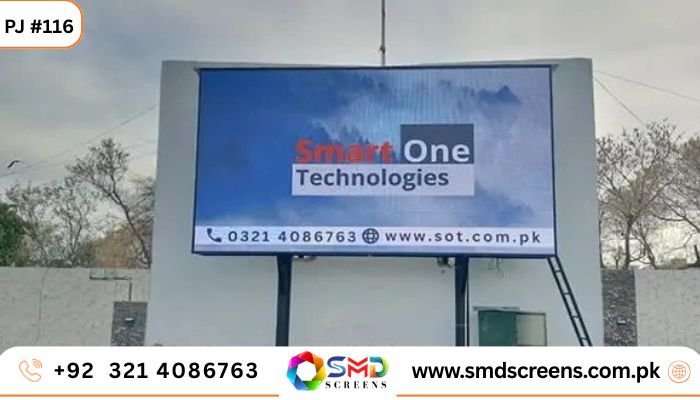
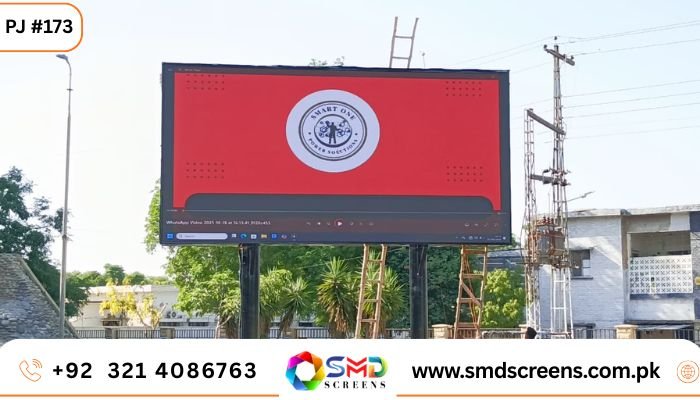
Outdoor SMD Screen Installation at MRF PAC Kamra: A Real-World Case Study
| TL;DR — Quick Answer MRF PAC Kamra commissioned a 10 x 20 foot Outdoor SMD Screen running on a P5 pixel pitch with Hikvision LED technology, built to stay sharp and readable under open sky conditions all year round. The install pairs sealed, weather-rated cabinets with a wind-braced support structure and a conditioned power system co-engineered with Smart One Power Solution, so the display keeps performing through Kamra’s heat, humidity, and grid fluctuations. |
Introduction
Not every display gets the luxury of a climate-controlled room. Screens mounted outdoors have to earn their keep against direct sun, shifting temperatures, dust, and — in many parts of Pakistan — power that isn’t always steady. MRF PAC Kamra needed exactly this kind of hard-working display: something large enough to communicate clearly across an open outdoor space, bright enough to beat the glare of a midday sun, and rugged enough to keep operating through Kamra’s full range of weather without constant intervention.
The answer was a purpose-built Outdoor SMD Screen, sized at 10 x 20 feet, running a P5 pixel pitch and built on Hikvision LED hardware. This article walks through the reasoning behind that specification, the engineering that went into the install, and the power strategy that keeps it running — giving facilities in Kamra, Attock, and across Pakistan a clear picture of what a properly executed outdoor LED project actually involves.
Breaking Down Outdoor SMD Screen Technology
At its core, an outdoor SMD screen uses Surface Mounted Device LED chips mounted inside cabinets engineered to survive outside a building rather than inside one. That distinction matters more than it might sound. A panel rated only for indoor use, dropped into an outdoor setting, will typically fail within a season or two — either from moisture ingress, sun-related brightness fade, or heat stress on components never designed for it.
A genuinely outdoor-grade screen is built differently from the start:
- Cabinets sealed against rain, humidity, and blowing dust
- Brightness levels calibrated well above indoor standards to remain visible in daylight
- A mounting system engineered to resist wind loading rather than simple wall brackets
- LED modules chosen to tolerate a wide temperature range across seasons
- A pixel pitch matched to realistic outdoor viewing distances rather than close-up detail
That last point often gets misjudged. Buyers sometimes assume a finer pixel pitch is always the superior option, but outdoor screens are usually viewed from further away than indoor ones. A pitch like P5 is frequently the more sensible engineering choice — sharp enough to look clean at typical outdoor distances, without the extra cost and power draw of an unnecessarily dense LED array.
The MRF PAC Kamra Brief
The project scope at MRF PAC Kamra was built around a single large-format outdoor display: 10 x 20 feet in size, P5 pixel pitch, constructed entirely from Hikvision outdoor SMD cabinets. Delivering that display involved several coordinated stages of work:
- On-site environmental assessment, covering sun path across the day, wind exposure, and the closest usable power source
- Structural planning for a mounting system capable of safely carrying a 10 x 20 foot cabinet array under wind load
- Procurement and staging of Hikvision P5 outdoor LED cabinets, chosen for daylight brightness and sealed construction
- Weatherproofing every cabinet junction — seams, cable glands, rear access points — to permanently block moisture and dust
- Installing outdoor-grade cabling for signal and power, protected against Kamra’s humidity and seasonal temperature shifts
- Designing the power system together with Smart One Power Solution, so the screen can absorb outages and voltage swings without interruption
- Field calibration under natural daylight, followed by full system testing and commissioning
The team scheduled structural and mechanical work during standard hours, while brightness tuning — which has to be done under real sunlight to be accurate — was timed around Kamra’s daily light conditions.
The Logic Behind the Specification
Choosing a P5, Hikvision-based, 10 x 20 foot outdoor screen for MRF PAC Kamra wasn’t a default configuration — it came from weighing three practical factors specific to the site.
Distance-appropriate resolution
Given the 10 x 20 foot scale of this screen and its typical outdoor viewing range, P5 delivers a clean, legible image without over-specifying LED density that would add cost and power draw without a visible benefit to viewers.
A hardware brand built for exposure
Hikvision’s outdoor SMD product line has a solid history in sealed, long-term outdoor deployments. For a screen meant to keep working through repeated hot seasons and monsoon periods at Kamra, that kind of proven weatherproof construction matters more than a marginally lower price tag from an unfamiliar brand.
Power planning as a first-order design decision
A screen of this footprint pulls significant power, and outdoor electrical supply tends to be less stable than what’s available indoors. Rather than treating backup power as an add-on, the system was designed from day one in coordination with Smart One Power Solution, building resilience directly into the electrical architecture.
How the Build Was Executed
Stage 1: Understanding the Site Before Design Begins
Before any structural work started, the team spent time studying how sunlight tracks across the MRF PAC Kamra installation area throughout the day, noting prevailing wind patterns, and identifying the nearest suitable power connection. Outdoor projects that skip this groundwork tend to run into avoidable problems later — glare in the wrong hours, or a mounting point that can’t handle real wind conditions.
Stage 2: Engineering a Structure Built for the Load
A screen spanning 10 x 20 feet carries real weight and real wind resistance. The support frame was purpose-engineered for this specific footprint, rather than adapted from a smaller, lighter-duty mounting kit — a shortcut that tends to cause problems well after installation day.
Stage 3: Cabinet Mounting and Full Weatherproofing
Hikvision cabinets were installed in a precisely aligned grid, with every seam, cable entry, and access panel sealed against water and dust intrusion. This step is what genuinely separates an outdoor-rated screen from an indoor unit that’s simply been relocated outside.
Stage 4: Running Cable Infrastructure for Outdoor Duty
Both video signal and power cabling were routed through outdoor-rated, moisture-sealed conduits designed to hold up against Kamra’s seasonal humidity and heat without degrading — a detail that’s inexpensive to get right at installation and costly to fix afterward.
Stage 5: Building Power Resilience With Smart One Power Solution
Large outdoor screens are especially exposed to power quality issues, and MRF PAC Kamra’s electrical environment was no exception. The team worked with Smart One Power Solution to design a conditioned power supply with backup capability, so the Outdoor SMD Screen keeps running cleanly through voltage dips and brief outages instead of flickering, restarting, or risking damage to the LED modules.
Stage 6: Calibrating for Real Daylight Conditions
Rather than relying on out-of-the-box brightness settings, the team calibrated the display under actual sunlight at different times of day, ensuring consistent readability from early morning glare through to late afternoon light.
Stage 7: Final Testing and Facility Handover
The project wrapped up with extended operational testing, a check of all weatherproof seals, verification that the backup power system engaged correctly during a simulated outage, and a walkthrough with MRF PAC Kamra staff covering day-to-day operation and basic upkeep.
The Practical Payoff of a Well-Built Outdoor Screen
Facilities evaluating a similar outdoor display investment usually want a straightforward answer: what does this actually deliver? Drawing on how the MRF PAC Kamra screen performs, the real-world benefits include:
- Consistent legibility even under direct midday sun
- Resistance to rain, dust, and Kamra’s full seasonal temperature swing
- A modular cabinet design that can scale to different sizes for future projects
- Noticeably lower maintenance demands than older outdoor display formats
- Dependable uptime, particularly with proper power backup engineered in
- A visual footprint large enough to serve communication needs across a wide outdoor area
These same principles carry over to other outdoor use cases — advertising displays, transport hubs, stadiums, and any facility that needs a large, sunlight-readable screen built to last.
Obstacles That Commonly Undermine Outdoor Installations — and How They Were Handled Here
Sunlight overpowering the display. Addressed by specifying genuinely high-brightness Hikvision hardware and fine-tuning calibration on-site rather than trusting generic factory defaults.
Moisture or dust entering the cabinets. Addressed by sealing every potential entry point — seams, glands, access panels — as a core installation step rather than a post-installation fix.
Wind pressure on a large panel array. Addressed with a mounting structure engineered specifically for the 10 x 20 foot footprint and its wind exposure, not a generic frame.
Unreliable outdoor power. Addressed through the conditioned, backed-up electrical system developed with Smart One Power Solution, which shields the screen from spikes, dips, and short outages alike.
Sustaining Performance Over Time
Outdoor LED displays experience more environmental wear than indoor units, so ongoing support is built into the plan for MRF PAC Kamra. That includes periodic inspection of seals and structural mounts, availability of spare Hikvision cabinets for quick module swaps, seasonal checks ahead of monsoon weather, and a direct line for urgent support requests. This kind of structured maintenance is what keeps the screen close to its original brightness and reliability well beyond the first year of use.
Understanding What Drives the Price
Budgeting for an outdoor SMD screen means accounting for several independent cost factors rather than expecting one flat number:
- Pixel pitch — P5, as specified here, is a practical, cost-efficient choice for medium-to-long outdoor viewing distances
- Screen size — priced against active display area, as with the 10 x 20 foot build at MRF PAC Kamra
- Hardware brand — Hikvision’s proven outdoor reliability comes with a fair premium over unverified alternatives
- Structural engineering — a wind-rated mount adds cost but safeguards the long-term investment
- Power infrastructure — conditioned supply and backup, delivered in partnership with providers like Smart One Power Solution
- After-sales coverage — warranty length and scheduled maintenance visits
A transparent quote should list these separately, so decision-makers can see precisely where their budget is being spent.
Frequently Asked Questions
What does a P5 pixel pitch mean in practical terms?
It describes a 5-millimeter spacing between LED clusters, a balanced choice for outdoor screens viewed from moderate distances — sharp enough for clarity without unnecessary cost or power draw.
Why was Hikvision selected for this outdoor screen?
Hikvision’s outdoor SMD cabinets are engineered with sealed, weather-rated housings and carry a strong track record in long-running outdoor deployments, which suited MRF PAC Kamra’s requirement for years of reliable service.
Does an outdoor screen of this size really need backup power?
Yes — a screen this size is vulnerable to voltage instability and outages without one. The MRF PAC Kamra installation uses a backup system engineered with Smart One Power Solution specifically to prevent interruptions or hardware damage.
How is the screen protected against rain and dust?
Through fully sealed cabinet housings and carefully treated cable entries and access panels, keeping moisture and dust away from the internal electronics entirely.
What’s a realistic timeline for a project like this?
From the initial site survey through structural work, cabling, calibration, and final commissioning, a 10 x 20 foot outdoor screen installation typically takes a few weeks, depending on site-specific factors.
Closing Thoughts
The Outdoor SMD Screen now operating at MRF PAC Kamra — 10 x 20 feet, P5 pixel pitch, built on Hikvision hardware — is a clear example of what happens when weatherproofing, structural planning, and power engineering are all given equal priority from the outset. The power backup system built with Smart One Power Solution keeps the display running reliably even when Kamra’s grid supply falters, while the sealed Hikvision cabinets are engineered to hold up through years of continuous outdoor exposure. Any institution, industrial site, or commercial facility in Kamra or elsewhere in Pakistan considering a similar outdoor display now has a concrete, field-tested example to work from.
| Planning an Outdoor SMD Screen Installation Near Kamra? SMD Screens Pakistan specified and installed the MRF PAC Kamra outdoor video screen from initial survey to final handover. If your facility needs a large-format outdoor display, digital signage, or sunlight-legible screen, our team can help you get the pixel pitch, weatherproofing, and power backup right from day one. Explore our Outdoor SMD Screen solutions or contact our team today for a free site assessment and quotation. |