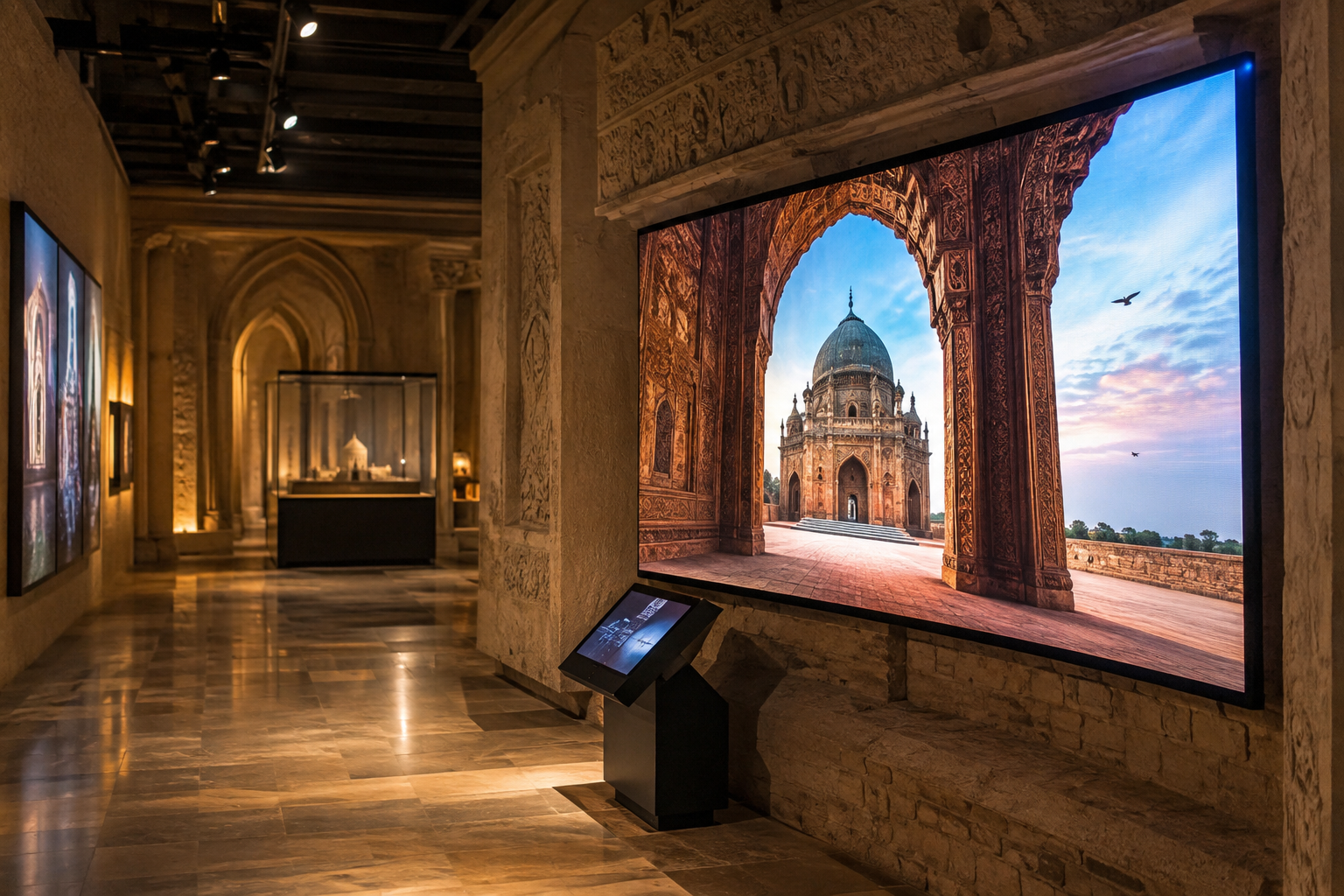
SMD Screens for Museums & Heritage Sites in Pakistan: Preserving History Through Digital Displays
| TL;DR — Quick Answer
SMD Screens Digital Displays are increasingly used in Pakistani museums and heritage sites to present historical context, artifact information, and immersive storytelling without exposing fragile relics to the damaging UV light and heat of traditional spotlighting. Unlike printed plaques or static signage, SMD Screens allow curators to update exhibit content, offer multilingual narration, and create large-format immersive video walls for orientation theatres and gallery entrances. A typical museum installation uses a fine pixel pitch of P1.8 to P2.5 for close-viewing information panels, moderate brightness suited to dim gallery lighting, and low-heat LED components that won’t harm nearby artifacts. Smart One Power Solution designs SMD Screens Digital Displays for cultural institutions with conservation-conscious brightness control and full content management support. |
Walk into any recently renovated museum or heritage centre in Pakistan and you’ll likely notice something new alongside the display cases and centuries-old artifacts — glowing screens quietly telling stories that a printed placard never could. From orientation theatres at the entrance to interactive information panels beside ancient relics, SMD Screens Digital Displays are becoming a meaningful part of how Pakistan’s cultural institutions present history to a modern audience. This article looks at exactly how museums and heritage sites are using SMD Screens Digital Displays, why they’re often a better fit than traditional signage or even LCD panels, and what curators and facility managers should consider before installing one — based on real institutional deployment experience from Smart One Power Solution.
Why Museums Are Turning to SMD Screens Digital Displays
Museums face a challenge that most commercial spaces don’t: the content they display has to inform, educate, and often move visitors emotionally, while the objects being described are frequently irreplaceable and sensitive to light and heat exposure. Traditional halogen spotlighting used to illuminate exhibits and printed signage can contribute to long-term fading and material degradation, and static text panels can’t easily be updated as new research emerges or as exhibits rotate. SMD Screens Digital Displays address several of these concerns at once — offering low-heat LED illumination, easily updatable multimedia content, and immersive large-format storytelling that static signage simply cannot replicate.
Where SMD Screens Digital Displays Are Used in Museums and Heritage Sites
Orientation Theatres and Entrance Video Walls
Many modern museums greet visitors with a large-format video wall or an immersive introductory theatre that sets the historical context before visitors move into the galleries themselves. A seamless, bezel-less SMD video wall creates a far more cinematic first impression than a projector screen or a bank of separate monitors.
Artifact Information and Interpretive Panels
Placed beside display cases, close-viewing SMD Screens Digital Displays present historical context, translations, and interpretive commentary that can be updated as curatorial research develops, without the cost and waste of reprinting physical signage every time information changes.
Interactive Timelines and Storytelling Walls
Large-format digital timelines let visitors trace a civilization, dynasty, or historical event across a continuous, high-resolution wall, often combined with touch interactivity so visitors can explore specific periods or artifacts in greater depth at their own pace.
Wayfinding and Gallery Navigation
Heritage sites with multiple halls, courtyards, or outdoor sections benefit from digital wayfinding screens that guide visitors between galleries, restrooms, and amenities, particularly useful for larger complexes and fort or monument sites with sprawling layouts.
Outdoor Heritage Site Displays
For open-air heritage sites and monument complexes, weatherproof outdoor SMD Screens can present historical information, restoration project updates, or visitor guidance at entrances and courtyards without the maintenance burden of printed outdoor signage exposed to sun and rain.
SMD Screens Digital Displays vs Traditional Museum Signage
| Factor | SMD Screens Digital Displays | Traditional Printed Signage |
| Content updates | Instant, remote content management | Requires reprinting and physical replacement |
| Light exposure risk to artifacts | Low-heat LED, controllable brightness | Spotlighting can contribute to fading over time |
| Multilingual support | Switch languages digitally in seconds | Needs separate printed panels per language |
| Visual impact | Large-format, immersive, video-capable | Static, limited to text and images |
| Long-term cost | Higher upfront, lower ongoing cost | Lower upfront, recurring reprint costs |
Conservation-Conscious Display Specifications
Museum environments come with a specific set of technical requirements that differ from a typical retail or corporate installation. Gallery lighting is usually kept deliberately low to protect sensitive materials, so SMD Screens Digital Displays used in these spaces should run at a moderate, carefully calibrated brightness rather than the higher nit ratings suited to daylight-heavy retail environments — a distinction covered in more depth in our guide on How to Choose SMD Screen Brightness for Indoor and Outdoor Environments. For close-viewing interpretive panels beside artifacts, a fine P1.8 to P2.5 pixel pitch, detailed in our P2.5 SMD Screen guide, keeps text and imagery sharp at the short distances visitors typically stand from exhibit cases.
Protecting Artifacts While Enhancing the Visitor Experience
- Low-heat LED technology generates significantly less radiant heat near display cases than traditional halogen or incandescent lighting fixtures.
- Adjustable brightness and colour temperature settings help avoid harsh contrast between screen content and dimly lit gallery surroundings.
- Digital content removes the need for repeated printing, handling, and adhesive mounting near fragile display areas.
- Scheduled dimming or automatic shutdown during closed hours reduces unnecessary light exposure and energy use overnight.
- Modular LED cabinets allow for non-invasive installation that avoids drilling or structural changes to protected heritage architecture where required.
Accessibility and Educational Value
Beyond conservation, SMD Screens Digital Displays give curators tools that printed panels simply cannot match for accessibility and engagement. Multilingual toggling allows the same panel to serve Urdu, English, and regional-language speaking visitors without cluttering the display with multiple printed translations. Video and audio-supported content can accommodate visitors who benefit from spoken narration alongside text, and interactive touch elements allow school groups and researchers to explore historical material at a depth that a single paragraph of printed text cannot provide. For heritage education programmes in particular, this kind of layered, digital storytelling has become an increasingly important part of how institutions engage younger visitors.
Why Cultural and Government Institutions Trust Smart One Power Solution
With 15 years of experience in power systems and display technology, Smart One Power Solution has delivered institutional-grade SMD Screens and video wall installations for government and public-sector environments across Pakistan, where reliability, careful brightness calibration, and professional finish matter just as much as they do in a museum gallery.
This includes the Indoor SMD Video Wall installation at NAB Islamabad, a government institutional deployment built around precise calibration and dependable long-term operation — the same standards a heritage institution or museum authority would expect from a partner handling displays near irreplaceable cultural artifacts.
Planning a Museum or Heritage Site Display Project
- Conduct a lighting and conservation assessment alongside the display design phase, not as a separate afterthought.
- Choose brightness and colour temperature settings in consultation with conservation staff, not just AV vendors.
- Plan cabling and mounting with minimal structural intervention, particularly in protected or listed heritage buildings.
- Build in multilingual and accessible content support from the start rather than retrofitting it later.
- Establish a maintenance and content-update plan so exhibits stay current as curatorial research and collections evolve.
SMD Screens vs Projection Mapping and Touchscreen Kiosks
Museums exploring digital storytelling often compare SMD Screens against projection mapping or standalone touchscreen kiosks, and each has a different role to play. Projection mapping can create dramatic effects on textured surfaces like building facades or architectural models, but it depends on ambient darkness and loses impact in brightly lit galleries. Touchscreen kiosks work well for individual, self-paced exploration but don’t offer the large-format visual impact needed for a shared group experience like an orientation theatre. SMD Screens Digital Displays sit between the two, offering the visual scale and impact of projection with the reliability and brightness control of a fixed panel, all while remaining fully legible under normal gallery lighting conditions rather than requiring a darkened room.
Power Planning for Heritage Buildings
Older heritage buildings and protected monuments often have limited or ageing electrical infrastructure, which makes power planning an important part of any SMD Screens Digital Displays project in these settings. Installations need to account for the building’s existing electrical capacity, avoid invasive rewiring in protected structures where possible, and include backup power for continuous operation during outages. Our guide on SMD Screen Power Consumption Explained offers a useful starting point for estimating the electrical load a museum-scale installation will add to an existing heritage site’s power system.
The Growing Role of Digital Storytelling in Pakistani Heritage Preservation
As institutions like Lahore Museum, Lok Virsa, and various provincial archaeology departments continue modernising their public-facing exhibits, digital storytelling is becoming a bigger part of how Pakistan presents its history to both domestic visitors and international tourists. SMD Screens Digital Displays give these institutions a way to layer richer context, oral history recordings, and visual reconstructions of ruined or damaged sites onto the visitor experience — filling in gaps that physical artifacts alone often can’t convey. As more heritage sites across the country invest in this kind of technology, thoughtful, conservation-conscious installation is what will determine whether these displays genuinely enhance the visitor experience or simply become another piece of hardware competing for attention against the history itself.
Frequently Asked Questions
Are SMD Screens safe to use near delicate historical artifacts?
Yes, when properly specified. SMD Screens Digital Displays generate far less radiant heat than traditional spotlighting, and brightness levels can be calibrated to stay well within conservation-safe ranges for sensitive materials.
Can SMD Screens replace traditional museum signage entirely?
Many museums use a hybrid approach, keeping some physical signage for atmosphere and authenticity while using SMD Screens Digital Displays for content that benefits from regular updates, multilingual support, or multimedia storytelling.
What pixel pitch is best for museum information panels?
Close-viewing interpretive panels beside exhibits typically use a fine P1.8 to P2.5 pixel pitch for sharp text and imagery, while larger orientation theatre walls viewed from a distance can use a slightly coarser pitch.
Do museum SMD Screens need special brightness settings?
Yes. Since gallery lighting is often kept low to protect artifacts, museum displays typically run at a lower, carefully calibrated brightness than retail or outdoor installations, avoiding jarring contrast with the surrounding space.
Can outdoor heritage sites use SMD Screens for visitor information?
Yes, weatherproof outdoor-rated SMD Screens can be installed at monument entrances, courtyards, and open-air heritage complexes to display visitor information and historical context without the maintenance issues of printed outdoor signage.
Final Thoughts
Pakistan’s museums and heritage sites are custodians of history that deserves to be preserved carefully and presented compellingly, and SMD Screens Digital Displays are increasingly proving to be a tool that supports both goals rather than working against them. Done thoughtfully — with the right brightness, pixel pitch, and conservation input from curatorial staff — digital displays can protect fragile artifacts while making history more accessible and engaging for the visitors who come to experience it.
| Planning a digital display project for a museum or heritage site?
Smart One Power Solution provides conservation-conscious SMD Screens Digital Displays, video walls, and installation planning for museums, heritage sites, and cultural institutions across Pakistan. |