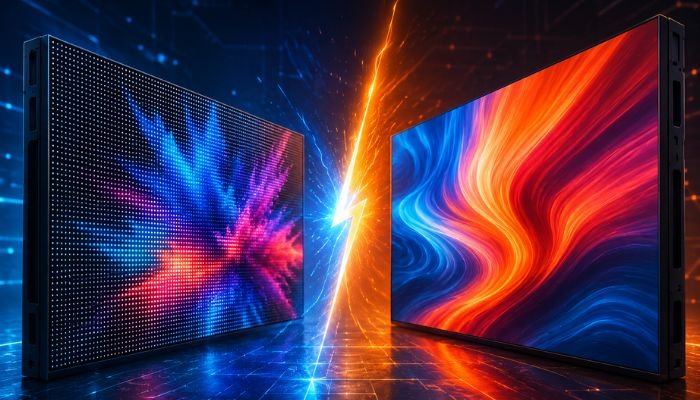
SMD Screen vs LED Screen: What’s the Real Difference in 2026?
If you have ever shopped for a display screen — whether for your shop front, office lobby, event stage, or outdoor billboard — you have almost certainly come across both of these terms: SMD screen and LED screen. And you have probably asked the same question that thousands of business owners across Pakistan ask every year: what is actually the difference between the two?
Here is the honest answer: the confusion is completely understandable, and it exists for a very good reason. The two terms are related — not competing technologies, exactly, but different points on the same technological spectrum. Understanding where one ends and the other begins will help you make a much smarter buying decision.
At Smart One Power Solutions, we field this question regularly. So in this article, we are going to cut through the jargon, explain both technologies clearly, compare them head to head across the factors that actually matter, and help you figure out which one is the right fit for your specific situation in 2026.
Let’s Start with the Basics: What Is an LED Screen?
LED stands for Light-Emitting Diode. At its most fundamental level, an LED screen is any display that uses light-emitting diodes to produce the images and content you see. This definition is deliberately broad — and that is precisely where the confusion begins.
The term “LED screen” has been used across the industry for decades, and it covers a wide family of display products. Early LED screens used large, discrete diodes arranged in a grid — the kind of display you would see on a scoreboard at a sports stadium in the 1990s or on an early outdoor billboard. The individual LEDs were relatively large, spaced apart, and only capable of producing low-resolution imagery from a distance.
Over time, LED technology evolved. The diodes got smaller, more power-efficient, and capable of producing better colour. But the fundamental architecture — individual through-hole LEDs mounted on a display panel — remained the dominant outdoor display technology for many years.
So when someone today says “LED screen,” they could mean any of several things: a traditional discrete-LED display, a modern high-resolution SMD panel, or even a consumer television that uses LED backlighting. The term is broad enough to be genuinely ambiguous, which is why understanding SMD specifically is so important.
So What Exactly Is an SMD Screen?
SMD stands for Surface-Mounted Device. An SMD screen is a specific type of LED screen — but it uses a fundamentally different manufacturing approach that produces a display with significantly superior characteristics.
In an SMD display, the red, green, and blue LED chips that form each pixel are not separate, through-hole components. Instead, all three colour chips are encapsulated together into a single, tiny component — the SMD package — which is then mounted directly onto the surface of the circuit board using automated machinery. This is the “surface-mounted” part of the name.
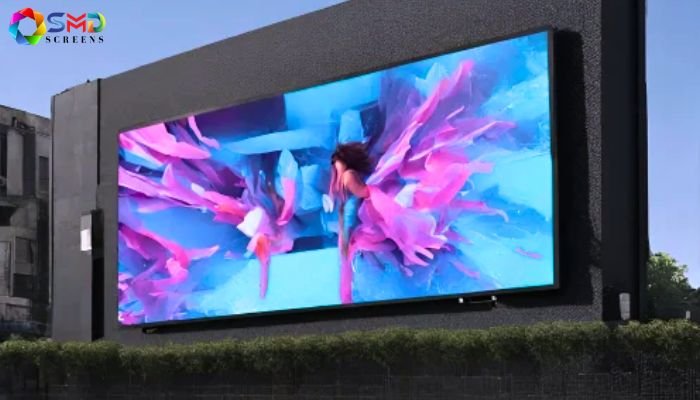
The result of this approach is a display where the individual pixels are much smaller, much more tightly packed, and produce a much more uniform, blended light output. Instead of seeing distinct red, green, and blue dots when you look at a screen up close, you see a single, cohesive colour — the same way you perceive colour on a smartphone or television screen.
The Pixel Pitch Connection
One term you will frequently encounter when comparing LED and SMD screens is pixel pitch — the distance, measured in millimetres, between the centre of one pixel and the centre of the next. A smaller pixel pitch means more pixels per square metre, which means higher resolution and sharper images at closer viewing distances.
Traditional discrete LED screens typically have larger pixel pitches — P10, P16, P20, and above — which means they are only suitable for viewing from a significant distance. SMD technology has enabled pixel pitches as tight as P0.8, P1.2, P1.5, P2.0, and beyond, making high-resolution display possible at much shorter viewing distances and in a much wider range of environments.
SMD Screen vs LED Screen: The Head-to-Head Comparison
Now that we understand what each technology actually is, let us compare them across the dimensions that matter most to businesses making a display investment:
Image Quality and Resolution
This is where SMD screens pull clearly ahead. Because SMD packages are smaller and more densely packed, they produce significantly higher resolution displays with smoother gradients, more accurate colour reproduction, and better overall image quality. For content that includes detailed graphics, brand imagery, product photography, or video, an SMD screen delivers a noticeably superior result.
Traditional LED screens with large pixel pitches produce acceptable results for simple text and basic graphics viewed from a distance — think a scoreboard or a basic price display. For anything more visually demanding, SMD is the clear choice.
Viewing Distance and Angle
Traditional LED screens are designed to be viewed from a specific minimum distance. Get too close, and the individual pixels become visible and the image appears fragmented. SMD screens, with their tighter pixel pitch, can be viewed from much closer distances without losing visual coherence.
Viewing angle is also significantly better with SMD technology. The encapsulated design of SMD packages means they emit light more uniformly in a wider arc, so the display looks consistent whether you are viewing it from directly in front or from a wide angle to the side. This matters enormously for large outdoor installations or indoor screens positioned in spaces where viewers approach from multiple directions.
Brightness and Outdoor Visibility
Both traditional LED and SMD displays can achieve high brightness levels suitable for outdoor use. However, modern outdoor SMD screens — particularly those from Smart One Power Solutions rated at 5,000 nits and above — combine exceptional brightness with far superior colour accuracy and contrast. The result is an outdoor display that looks genuinely impressive in full daylight, not merely visible.
Traditional LED screens can be bright, but the colour accuracy and contrast at high brightness levels is generally inferior to modern SMD technology.
Physical Appearance and Aesthetics
This difference is immediately obvious when you stand in front of both technologies. A traditional LED screen has a surface texture — you can see the individual LED components, the gaps between them, and the physical structure of the display module. It looks, in a word, industrial.
An SMD screen has a flat, smooth, visually uniform surface. When it is off, it looks like a dark, matte panel. When it is on, the entire surface glows uniformly, without visible gaps or individual component protrusions. For businesses where the display is part of the brand environment — a retail store, a hotel lobby, a corporate reception — this aesthetic difference is very significant.
Weight and Installation
SMD screen panels are generally lighter and thinner than equivalent-sized traditional LED displays. This makes them easier to transport, simpler to install, and more flexible in terms of the mounting configurations they can support. Wall-mounted indoor installations, ceiling-hung panels, and curved or creative display shapes are all far more practical with SMD technology.
Energy Efficiency
Modern SMD screens use significantly less power than older traditional LED displays for equivalent brightness levels. The SMD architecture allows for more efficient use of electricity, and advanced driver circuits combined with automatic brightness adjustment sensors reduce consumption further during low-light conditions. For businesses in Pakistan where electricity costs are a genuine operational concern, this efficiency advantage is worth factoring into the total cost of ownership calculation.
Cost
Traditional LED displays with large pixel pitches are generally cheaper per square metre than high-resolution SMD screens. This cost difference is real and should be considered honestly. However, it must be weighed against what you are actually getting: if your use case requires close viewing distances, high-quality imagery, or a premium aesthetic — all conditions that apply to most commercial applications — then the additional cost of SMD technology is fully justified by the superior output.
For applications where very large viewing distances are the norm — a motorway billboard visible only from 50 metres away, for example — a traditional LED display with an appropriate pixel pitch may be a cost-effective choice. But for the vast majority of business signage, retail, corporate, and events applications, SMD is the right technology.
Where Each Technology Makes Sense in the Pakistani Market
Understanding the technical differences is useful. Understanding how those differences translate into real-world application suitability is even more useful. Here is a practical guide:
Use Cases Where SMD Screens Are the Clear Choice
- Retail shop fronts and mall installations: Close viewing distances and the need for high-quality product imagery make SMD the only sensible choice.
- Indoor environments — offices, lobbies, conference rooms, hotels: Indoor SMD screens with tight pixel pitches deliver display quality that matches the professional environment they are placed in.
- Restaurant and hospitality displays: Food and beverage imagery needs to look appetising and vibrant — SMD colour accuracy and resolution deliver this; traditional LED cannot.
- Event stages and exhibition stands: Attendees are close to the display. SMD quality is essential.
- Corporate video walls: Multi-panel SMD video walls create seamless, high-resolution displays that project credibility and technological sophistication.
- Pole streamers and medium-distance outdoor signage: Where the screen is within 10 to 30 metres of viewers, SMD quality makes a visible difference.
Use Cases Where Traditional LED Displays May Still Be Considered
- Very large motorway or highway billboards: When the minimum viewing distance is 50 metres or more, the resolution advantages of SMD are less visible and a larger pixel pitch display may be cost-effective.
- Sports stadium perimeter displays: Long-distance viewing and simple content (scores, sponsor logos) may not justify the premium of very high-resolution SMD panels.
- Basic price or text information displays: Simple numerical displays in wholesale markets or parking facilities where aesthetics are not a priority.
It is worth noting that even in these traditionally “large LED” use cases, modern outdoor SMD screens are increasingly being specified because the cost premium has reduced significantly while the performance advantages remain substantial.
A Note on Terminology: Why the Market Uses Both Terms
One thing that causes persistent confusion in the Pakistani display market is the fact that many suppliers — and even some buyers — use “LED screen” and “SMD screen” interchangeably. Part of this is historical: LED was the established term before SMD became dominant, and old habits in sales conversations die hard.
Part of it is also intentionally ambiguous marketing. Calling an older, lower-resolution display an “LED screen” is technically accurate but omits the important detail that it uses a completely different — and inferior — display technology compared to a modern SMD screen.
When you are speaking to any display supplier, including Smart One Power Solutions, it is always worth asking specifically about pixel pitch, SMD vs discrete LED architecture, and the intended viewing distance. These questions will give you a clear picture of what you are actually being offered and whether it is the right solution for your needs.
What Smart One Power Solutions Recommends for 2026
Our recommendation to Pakistani businesses in 2026 is clear: for the overwhelming majority of commercial applications, SMD screen technology is the right investment. The performance gap between SMD and traditional discrete LED has only widened as SMD manufacturing has matured and costs have become more competitive.
The businesses we work with across Pakistan — from boutique retailers in Lahore’s commercial districts to large hotel groups in Karachi, from corporate offices in Islamabad to event management companies in Faisalabad — have consistently experienced better results with SMD technology. Better visual impact, better brand representation, better viewer engagement, and better long-term reliability.
- For indoor applications: We recommend SMD screens with pixel pitches between P1.2 and P3.0, depending on room size and viewing distance. These deliver display quality that is genuinely stunning in a professional interior environment.
- For outdoor applications: We recommend outdoor-rated SMD screens with IP65 weatherproofing, brightness of 5,000 nits or above, and pixel pitches between P3.0 and P6.0 for most urban commercial applications.
- For pole streamers and roadside displays: SMD pole streamer panels with portrait orientation and appropriate pixel pitch for the installation height and viewing distance.
- For video walls: Seamless SMD panels with ultra-thin bezels or bezel-free cabinet designs, configured for the specific dimensions of your installation space.
How to Make the Right Decision for Your Business
The decision between SMD and traditional LED comes down to four practical questions:
- What is the typical viewing distance? Under 30 metres, SMD wins clearly. Over 50 metres, traditional LED with a larger pixel pitch may be considered.
- What content will be displayed? High-quality video, images, and brand graphics require SMD. Simple text or numeric displays are less demanding.
- What is the environment? Indoor and premium outdoor environments call for SMD. Basic utility displays in industrial settings may not.
- What is the budget? SMD costs more upfront but delivers better value over the lifetime of the installation for most commercial applications.
If you are still uncertain after working through these questions, our team at Smart One Power Solutions is happy to consult with you, assess your specific situation, and give you an honest recommendation — even if that recommendation turns out to be a more cost-effective solution than the most premium option we offer.
The Bottom Line: SMD Is the Present and Future of LED Display Technology
In 2026, the gap between SMD screens and traditional LED displays is not closing — it is widening. SMD technology continues to improve in resolution, energy efficiency, reliability, and manufacturing cost. The case for traditional discrete LED in commercial applications grows weaker with each passing year.
For Pakistani businesses investing in display technology today, SMD screens represent the clear, forward-looking choice. They deliver better visual quality, greater flexibility, longer operational lifespans, and the kind of brand presence that genuinely differentiates a business in a competitive marketplace.
The real question in 2026 is not “SMD or LED?” — because SMD is LED, evolved. The real question is: which SMD screen specification is the right fit for your specific needs, environment, and budget? And that is exactly the conversation we love to have at Smart One Power Solutions.
Ready to Explore the Right SMD Screen Solution for Your Business?
Smart One Power Solutions offers a full range of indoor and outdoor SMD screens, video walls, pole streamers, digital signage, and custom display solutions for businesses across Pakistan. Our team of experts will help you identify the right technology, specification, and configuration for your exact requirements — with full installation, training, and after-sales support included.
Visit us at: smdscreens.com.pk