How to Connect SMD Screen to Your Computer or Media Player
| ⚡ TL;DR — Quick Answer To connect an SMD screen to a computer or media player, you need an LED controller card (such as Linsn, Nova Star, or Colorlight) that acts as the bridge between your source device and the SMD screen. Connect your PC/laptop to the controller card via HDMI or DVI, then connect the controller card to the SMD screen panels via network CAT5e/CAT6 cables. Install the matching control software, configure resolution settings, and your SMD screen will mirror or extend your display. Smart One Power Solution (smdscreens.com.pk) supplies all connection hardware, controller cards, and provides free setup support across Pakistan. |
Introduction
You’ve invested in an SMD screen — one of the most powerful visual communication tools available. But here’s a reality check that many first-time buyers in Pakistan discover after installation: an SMD screen doesn’t connect to a computer the same way a regular monitor does. It’s not just HDMI-in, display-out. There’s a crucial middle layer that most guides skip entirely — the LED controller card — and understanding this changes everything.
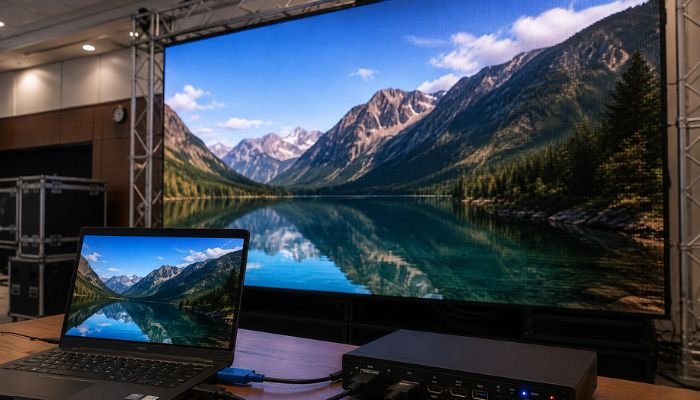
Whether you’re connecting your SMD screen to a Windows laptop for a wedding hall presentation, hooking it up to a media player for a continuous outdoor billboard loop, or integrating it into a full-blown video wall system at a corporate head office — the connection process follows a clear, logical sequence that anyone can follow.
This guide, prepared by the technical team at Smart One Power Solution, walks you through every connection method, every cable type, and every software step needed to get your SMD screen running perfectly — first time, every time.
Understanding the SMD Screen Connection System: What You’re Actually Connecting
Before touching a single cable, you need to understand the architecture of an SMD screen connection system. Unlike an LCD monitor that accepts a direct HDMI signal, an SMD LED display processes video data through a specialised hardware layer. The system has three main components working together:
Component 1 — The Source Device
This is the device generating your content — a Windows desktop, laptop, media player, Raspberry Pi, or dedicated broadcast server. The source device outputs a standard video signal (HDMI, DVI, or DisplayPort) that the rest of the system will process and display on your SMD screen.
Component 2 — The LED Controller Card (Sending Card)
This is the critical bridge that most people miss. The LED sending card (also called a controller card or sending unit) receives your video signal from the source device via HDMI or DVI, converts it into LED-specific data packets, and transmits this data to the SMD screen panels via Ethernet cables. Popular controller card brands include Linsn, Nova Star, Colorlight, and Huidu — all available through Smart One Power Solution in Pakistan.
Component 3 — The Receiving Card (Hub Card)
Inside your SMD screen cabinet or module, receiving cards (hub cards) accept the data signal from the sending card via CAT5e or CAT6 network cables and distribute it to the individual LED modules. Each receiving card typically drives a section of your SMD screen. Multiple receiving cards can be daisy-chained for large displays.
| 🔗 SMD Screen Connection Flow Source Device (PC/Laptop/Media Player) → HDMI/DVI cable → LED Sending Card → CAT5e/CAT6 cable → Receiving Card → SMD Screen Modules This flow applies to every SMD screen connection — indoor or outdoor, small or large. |
What You Need Before Connecting Your SMD Screen
Gather all of the following before starting the connection process. Smart One Power Solution supplies all these items as part of their SMD screen installation packages:
| Item Required | Purpose | Recommended Spec |
| LED Sending Card | Converts PC video signal to LED data | Linsn TS802D / Nova Star MSD300 / Colorlight 5A |
| HDMI or DVI Cable | Connects PC/media player to sending card | High-speed HDMI 2.0 or DVI-D Dual Link |
| CAT5e / CAT6 Cables | Connect sending card to SMD screen | Cat6 for runs over 50 metres |
| LED Receiving Cards | Installed inside SMD screen cabinets | Must match sending card brand |
| Power Supply Unit | Powers controller card and LED panels | 5V DC for cards; specific per SMD screen type |
| Control Software | Configures sending card and screen settings | Linsn LED Studio / Nova LCT / Colorlight Cloud |
| Windows PC or Laptop | Runs control software for configuration | Windows 10/11, minimum 8GB RAM |
| Media Player (Optional) | Autonomous content playback without PC | Linsn A8 / Nova Star MCTRL / Colorlight X4 |
How to Connect SMD Screen to a Computer
Follow these steps in order. Skipping steps — especially software configuration — is the leading cause of SMD screen display problems during initial setup.
| Step 1: Install the LED Sending Card in Your PC Desktop PC: Open the PC case and insert the LED sending card into an available PCIe or PCI slot. The sending card has a DVI/HDMI input port and multiple Ethernet output ports. Secure with a screw and close the case. Laptop users: Use an external USB-to-DVI adapter connected to a standalone LED sending card unit (a box-type sender). Smart One Power Solution stocks box-type senders like the Colorlight FIBER+ for laptop connections. Important: The LED sending card is NOT a standard graphics card. Do not connect your monitor to it — connect your regular monitor to the PC’s existing GPU, and only connect the sending card output to the SMD screen. |
| Step 2: Connect PC to Sending Card via HDMI or DVI Run a DVI-D or HDMI cable from your PC’s graphics output to the input port of the LED sending card. This is a mirror/clone connection — the sending card captures whatever your graphics card outputs on that port. DVI-D is preferred for most LED sending cards because it provides a direct digital signal without HDCP encryption that can interfere with LED processing. If using HDMI, ensure the cable is HDMI 1.4 or higher. Keep this cable under 3 metres for reliable signal quality. For longer runs, use an HDMI signal extender or switch to a fibre-optic HDMI cable. Smart One Power Solution recommends Linsn TS802D sending cards as they accept both DVI and HDMI natively. |
| Step 3: Connect Sending Card to SMD Screen via CAT6 Cables The Ethernet output ports on the sending card connect to the receiving cards inside your SMD screen cabinets using standard CAT5e or CAT6 network cables (standard RJ-45 connectors — no special cables required). Single output port: For small SMD screens (under 640×480 pixels resolution), one CAT6 cable from one output port is sufficient. Multiple output ports: Larger SMD screens use multiple cables from different output ports, each feeding a section of the display (called a ‘zone’ or ‘group’). The sending card software maps which output drives which screen zone. For outdoor SMD screens where the sending card is far from the display, CAT6 cables reliably carry signal up to 100 metres. Beyond that, use fibre-optic converters — available from Smart One Power Solution for all long-run outdoor installations. |
| Step 4: Install LED Control Software on Your PC Install the control software matching your sending card brand. This software communicates with the sending card to configure your SMD screen resolution, brightness, colour calibration, and display zones: Linsn sending cards: Install ‘LED Studio’ (free download from Linsn website) Nova Star cards: Install ‘Nova LCT’ (Nova Star’s LED Configuration Tool) Colorlight cards: Install ‘Colorlight Cloud’ or ‘EasyLocal’ Huidu cards: Install ‘HD Player’ or ‘HD Control’ software Smart One Power Solution provides pre-configured software and walk-through setup support for all sending card brands they supply — eliminating the frustration of manual configuration from scratch. |
| Step 5: Configure Resolution and Screen Mapping Open the control software and run the hardware scan — the software will detect your sending card and the receiving cards connected to your SMD screen. Set screen resolution: Enter the exact pixel dimensions of your SMD screen (e.g., 192×96 pixels for a small P8 outdoor screen, or 512×288 for a medium indoor display) Map screen zones: If using multiple CAT6 output cables, assign each output port to its corresponding section of the SMD screen in the software’s visual mapper Set refresh rate: Match the sending card’s output refresh to the SMD screen’s receiving card specification (typically 60Hz for most applications) Calibrate brightness: Set initial brightness to 50% for indoor, 80%+ for outdoor SMD screens |
| Step 6: Set Windows Display Settings On your Windows PC, right-click the desktop → Display Settings. Your system should show two displays — your regular monitor and the SMD screen (via the sending card). For content playback (recommended): Set the SMD screen as a ‘Second Screen Only’ or ‘Duplicate’ display For presentations: Use ‘Extend’ mode — your regular monitor runs presentations software while the SMD screen shows the extended display Crucial: Set the resolution of the SMD screen display in Windows to exactly match the pixel dimensions you configured in the LED control software. Mismatched resolutions are the most common cause of distorted images on SMD screens |
Connecting SMD Screen to a Media Player (No PC Required)
For permanent installations — outdoor SMD billboards, retail LED displays, or stadium screens — running a full PC continuously is impractical. A dedicated LED media player provides autonomous, reliable content playback without a computer.
How LED Media Players Work
An LED media player (also called an async controller or standalone player) combines the functions of a PC and a sending card into one device. You upload your content (videos, images, text) via USB drive or Wi-Fi app, and the media player loops it continuously on your SMD screen without any external device needed.
| Media Player Model | Best For | Connection Type | Content Update Method |
| Linsn A8 / A10 | Outdoor SMD billboards | CAT6 to SMD panels | USB drive or app |
| Nova Star MCTRL660 | Large indoor SMD screens | CAT6 multi-output | Wi-Fi / LAN / USB |
| Colorlight X4 | Mid-size indoor/outdoor | CAT6 dual output | Wi-Fi app or USB |
| Huidu HD-A601 | Cost-effective outdoor | CAT6 single/dual | USB / 4G LTE option |
| Linsn A3s (Wi-Fi) | Small shop SMD displays | CAT6 output | Smartphone app |
Steps to Connect SMD Screen to a Media Player
- Connect media player to SMD screen: CAT6 cable from the media player’s Ethernet output port to the receiving card input on your SMD screen cabinet — exactly as with the PC sending card method
- Power the media player: Connect the 5V DC power supply to the media player (usually included)
- Install the companion app: Download the brand’s management app on your smartphone (e.g., ‘Nova App’ for Nova Star, ‘LED Smart’ for Linsn)
- Upload content: Transfer your video files (MP4 recommended) and images (JPG/PNG) to a USB drive formatted as FAT32, then insert into the media player — or upload directly via the Wi-Fi app
- Configure playback schedule: Set content rotation, display duration, and scheduled on/off times through the app
- Test and confirm: Your SMD screen should immediately begin displaying the content in a continuous loop
Wireless and Network Connection Options for SMD Screens
Modern SMD screen setups increasingly use network-based control systems, eliminating long cable runs and enabling remote content management from anywhere in Pakistan.
Wi-Fi Controller Cards
Wi-Fi enabled sending cards allow you to connect your SMD screen to a local wireless network. Once connected, any PC or smartphone on the same network can push content to the SMD display without physical cables to the source device. The Colorlight CLOUD series and Nova Star Wi-Fi modules (available at Smart One Power Solution) are popular examples.
4G/LTE Remote Management
For outdoor SMD billboards in locations without reliable internet, 4G LTE controller modules allow remote content updates via mobile data. Content managers in Karachi can update a SMD screen in Peshawar in real time. Smart One Power Solution integrates 4G management systems into all their remote outdoor LED display installations.
Cloud-Based CMS Integration
Enterprise SMD screen networks — such as a chain of retail stores across multiple Pakistani cities — use cloud-based Content Management Systems (CMS) to push scheduled content to all screens simultaneously. Smart One Power Solution provides CMS setup and integration as part of their complete SMD screen installation packages.
Troubleshooting Common SMD Screen Connection Problems
Even with correct cabling, SMD screen connection issues do occur. Here are the most common problems and their solutions:
| Problem | Most Likely Cause | Solution |
| SMD screen shows no image | PC resolution mismatch with LED software | Match Windows display resolution exactly to pixel dimensions in control software |
| Half the screen is dark/blank | CAT6 cable unplugged or faulty | Check all CAT6 connections from sending card to receiving cards |
| Image appears scrambled | Wrong screen dimensions entered in software | Re-enter correct pixel width and height in LED control software |
| Screen flickers or strobes | Refresh rate mismatch | Set sending card refresh rate to 60Hz; update receiving card firmware |
| Colour looks washed out | Brightness set too low or gamma incorrect | Adjust brightness in control software; run colour calibration wizard |
| PC doesn’t detect SMD screen | Sending card driver not installed | Reinstall sending card driver; use Device Manager to verify detection |
| Content plays wrong aspect ratio | Source resolution doesn’t match screen ratio | Crop or letterbox content to exact screen pixel dimensions before upload |
| CAT6 signal drops at distance | Cable quality or run length exceeded | Replace with Cat6A cable; use fibre converter for runs over 100m |
Why Smart One Power Solution Is Pakistan’s Go-To SMD Screen Connection Expert
Connecting an SMD screen properly requires the right hardware, software configuration knowledge, and experience with real-world installation challenges. Smart One Power Solution (smdscreens.com.pk) brings all three to every project in Pakistan:
- Complete Hardware Supply: Sending cards, receiving cards, CAT6 cables, media players, power supplies, and all accessories from globally trusted brands — Linsn, Nova Star, Colorlight, Huidu — with genuine warranty.
- Free Connection Consultation: Not sure which sending card to buy or how to cable your specific SMD screen setup? Smart One Power Solution’s technical team provides free consultation before every purchase.
- On-Site Installation: Certified installation engineers set up complete SMD screen systems — from sending card installation to software configuration and content testing — across all major Pakistani cities.
- Software Configuration Service: If LED control software configuration feels overwhelming, Smart One Power Solution’s team can remotely configure your sending card or visit on-site to complete the setup.
- After-Sales AMC Support: Annual Maintenance Contracts keep your SMD screen connection hardware maintained, with emergency technical support when you need it most.
- Training & Handover: Every SMD screen installation by Smart One Power Solution includes hands-on training for your team — so you know how to switch content, adjust brightness, and manage your display independently.
| 🎯 Get Your SMD Screen Connected the Right Way Don’t spend days troubleshooting connection issues that a professional setup avoids entirely. Visit smdscreens.com.pk to browse sending cards, receiving cards, media players, and complete SMD screen connection solutions — or contact Smart One Power Solution directly for free setup consultation. |
Frequently Asked Questions About SMD Screen Connection
Q: Do I need a special cable to connect an SMD screen to my computer?
A: Not a special cable, but you do need a standard HDMI or DVI cable from your PC to the LED sending card, and standard CAT5e or CAT6 network cables from the sending card to the SMD screen’s receiving cards. Regular USB or VGA cables won’t work for SMD screen connections.
Q: Can I connect an SMD screen to a MacBook or Mac computer?
A: Yes, with caveats. Mac computers can connect to LED sending cards via HDMI using a USB-C to HDMI adapter. However, LED control software (Linsn LED Studio, Nova LCT, etc.) is Windows-only. For Mac-based systems, Smart One Power Solution recommends using a standalone LED media player that handles control separately from the Mac content source.
Q: What is the maximum cable length between a sending card and an SMD screen?
A: Standard CAT5e and CAT6 cables reliably carry the LED data signal up to 100 metres between the sending card and receiving cards. For longer distances, use fibre-optic converters. Smart One Power Solution supplies both CAT6 cable assemblies and fibre converter kits for large outdoor SMD screen installations.
Q: Can one sending card drive multiple SMD screens simultaneously?
A: Yes. Most professional sending cards (like the Linsn TS802D or Nova Star MSD300) have multiple Ethernet output ports, each of which can drive a separate section or an entire independent SMD screen. The total pixel load across all outputs must stay within the sending card’s maximum pixel capacity.
Q: How do I update content on an SMD screen without a PC on-site?
A: Use a standalone LED media player with a Wi-Fi module or 4G LTE option. Smart One Power Solution installs Colorlight and Nova Star media players that allow remote content updates via smartphone app or browser-based CMS — no on-site PC required, perfect for outdoor SMD billboards across Pakistan.
Conclusion
Connecting an SMD screen to a computer or media player follows a clear, logical path once you understand the three-component system: source device, LED sending card, and receiving cards. The connection process itself — HDMI from PC to sending card, CAT6 from sending card to SMD screen panels — takes minutes. The configuration step, where software maps your screen’s exact pixel dimensions, is what transforms a blinking display into a professional, stable visual installation.
The only way to guarantee a perfect SMD screen connection experience in Pakistan is to work with experts who have done it thousands of times before. Smart One Power Solution brings the right hardware, the right configuration knowledge, and genuine on-the-ground support to every SMD screen project — from a single retail shop display to a 20-screen outdoor billboard network.
Visit smdscreens.com.pk today for a free technical consultation. Whether you’re connecting your first SMD screen or scaling an existing LED display network, Pakistan’s most trusted SMD screen team is ready to help.
© 2026 Smart One Power Solution | smdscreens.com.pk | All Rights Reserved