Micro-LED Video Walls in Pakistan: P0.8 to P1.2 Ultra-Fine Pitch Boardroom Displays
| Quick Answer Micro-LED displays utilize self-emissive microscopic inorganic diodes (sub-P1.0 pitch) encapsulated via Chip-on-Board (COB) packaging. Delivering true 1,000,000:1 contrast ratios, deep blacks, and zero bezel lines, Smart One Power Solutions (SOPS) engineers premium P0.8 and P0.9 Micro-LED video walls for executive boardrooms, defense command rooms, and broadcast studios in Pakistan. |
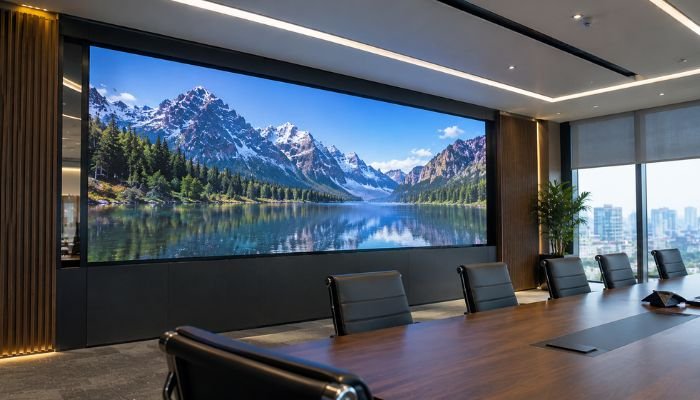
An executive boardroom has a unique problem. People sit one or two metres from the screen, they read small figures on dense slides, and the room is lit for note-taking. Standard LED walls show visible pixels at that distance, and large LCD panels bring bezel lines through every chart. Ultra-fine pitch Micro-LED and COB walls were built for exactly this situation. This guide explains the technology, how to size a wall from P0.8 to P1.2, how the surface and image quality differ, and what drives the cost.
What Micro-LED and COB Actually Mean
In a traditional SMD screen, each LED is a small packaged lamp soldered to the board, with its own bead and legs. COB, or Chip-on-Board, removes that packaging. Bare LED chips, often in a flip-chip design, are bonded directly to the circuit board and sealed beneath one continuous layer of resin. With no bead to protrude and no solder legs to fail, pitches can shrink below one millimetre while the surface stays smooth.
A note on terminology: in the market today, fine-pitch COB walls are commonly sold as Micro-LED, and the performance gains are real. True mass-transfer Micro-LED, with chips under about 100 microns, is a related and even finer technology that remains far more expensive. When you compare quotations, ask the supplier to state the packaging method and chip size in writing.
SMD vs GOB vs COB Micro-LED
| Technology Tier | Pixel Pitch Range | Packaging Surface | Contrast Ratio | Optimal Viewing Distance |
| Standard SMD LED | P2.0 – P4.0 | Exposed Lamp Beads (Vulnerable to touch) | 3,000:1 | 2.5 to 5+ Meters |
| GOB (Glue-on-Board) | P1.5 – P2.5 | Epoxy Shielded SMD | 5,000:1 | 1.8 to 3 Meters |
| SOPS Micro-LED / COB | P0.78 – P1.25 | Integrated Matte Resin (Impact & Dust Proof) | 1,000,000:1 (Infinite Black) | 0.8 to 1.5 Meters (Ultra-Close Vision) |
Values are typical for each technology tier. Confirm exact contrast, pitch, and viewing figures on the datasheet of the model you choose, because contrast depends on room lighting.
Why Boardrooms Choose Ultra-Fine Pitch
- Close viewing without visible pixels. At P0.8 to P1.2, executives can sit about a metre from the wall and still see smooth text and photographs.
- Zero bezel lines. The canvas is continuous, so spreadsheets, maps, and dashboards run edge to edge with no interruptions.
- Deep blacks. Each diode is self-emissive, so a black pixel is simply off. The result is strong contrast and depth, even with the lights on.
- A tough surface. The resin layer resists dust, light impact, and accidental touch, which exposed lamp beads do not.
- A premium impression. A flush, seamless wall signals a serious organisation to every board member and visitor.
The same strengths suit defence command rooms and broadcast studios, where viewers are close, content is detailed, and cameras are present.
Pixel Pitch and Wall Sizing: P0.8 to P1.2
Pixel pitch is the distance between two neighbouring LEDs in millimetres. The closest comfortable viewer sits roughly as many metres away as the pitch number, and a little further is better. Matching the wall to a native resolution avoids scaling, so text stays crisp. These dimensions follow directly from the pitch.
| Pixel Pitch | Full HD wall (1920×1080) | 4K wall (3840×2160) | Closest comfortable viewer |
| P0.8 | 1.54 m × 0.86 m | 3.07 m × 1.73 m | From about 0.8 m |
| P0.9 | 1.73 m × 0.97 m | 3.46 m × 1.94 m | From about 0.9 m |
| P1.2 | 2.30 m × 1.30 m | 4.61 m × 2.59 m | From about 1.2 m |
A P0.8 Micro-LED display in Lahore, Karachi, or Islamabad suits a compact boardroom where the first seat is close, and a Full HD canvas of about 1.5 metres wide may be enough. Larger rooms and data-heavy content benefit from 4K. Mount the bottom edge roughly 0.9 to 1.1 metres from the floor so the image sits at natural eye level for seated participants.
Image Quality: Contrast, HDR, and Anti-Glare Surface
The quoted contrast ratio describes a dark room. In a lit boardroom, reflections from windows and ceiling lights lift the blacks, so the surface finish matters as much as the number. A matte resin surface with anti-reflective optical coatings scatters stray light instead of mirroring it, which keeps blacks deep and prevents glare on camera.
For HDR content, the wall needs brightness headroom, 16-bit grayscale processing, and a compatible controller and source. HDR10+ support depends on the processor and signal chain, so confirm it with the supplier before assuming it. Calibrate brightness to a comfortable few hundred nits for long meetings, and use point-by-point correction so colour and brightness stay uniform across every module.
Durability, Maintenance, and Repairs
COB surfaces are easy to live with. They can be wiped gently with a dry soft cloth, and they tolerate dust and humidity better than exposed beads. Repairs work differently, though. Individual chips are sealed in resin, so service usually means swapping a module rather than replacing a single lamp. Choose front-serviceable modules, and keep spare modules from the same batch, because colour can differ between production runs.
Boardroom Integration
- Connect through standard HDMI to Zoom Rooms or Microsoft Teams Rooms. Place the camera on the centre line, above or below the wall.
- Use a quality video processor with low latency and saved layouts, so staff can switch between laptop, camera, and split-screen views with one touch.
- Structure and flatness. Fine pitch exposes any unevenness. The wall needs a rigid, flat substrate and precise cabinet alignment.
- Power, heat, and sound. Choose fanless cabinets where possible, because a silent room matters, and protect the supply with surge protection against Pakistan’s grid fluctuations.
Fine-Pitch Micro-LED Price Factors
Ultra-fine pitch costs far more than standard SMD, and pitch drives most of the difference. The main factors are:
- Pixel pitch, since P0.8 packs more than twice the LEDs per square metre of P1.2
- Total area and native resolution
- Chip quality, packaging method, and cabinet precision
- Processing, HDR capability, and calibration
- Mounting structure, flatness tolerance, and installation access
- Warranty terms and spare module allowance
Ask for an itemised quotation that separates screen, processing, structure, and installation, so you can compare suppliers fairly.
Planning Checklist
Measure the distance from the wall to the nearest and farthest seats, then pick the pitch and native resolution from those distances. Confirm the packaging method, HDR support, and serviceability in writing. Check wall flatness, power, and ventilation, and approve a mockup before ordering. Finally, train the team on source switching, so the system is used confidently from the first meeting.
About SOPS
Smart One Power Solutions (SOPS) specialises in fine-pitch P0.8 to P1.8 Micro-LED video walls and delivers SOPS Micro-LED displays to executive boardrooms in Lahore, Karachi, and Islamabad. Its technology focus is COB chip-on-board construction combined with anti-reflective optical coatings. Explore the SOPS home page, compare models under Our Products, or see our Conference Room page for hybrid meeting setups.
Frequently Asked Questions
What is the difference between COB and Micro-LED?
COB is a packaging method where LED chips are bonded directly to the board and sealed under a continuous resin layer. Fine-pitch COB walls are widely sold as Micro-LED, while true mass-transfer Micro-LED is an even finer, costlier related technology.
What pixel pitch is best for an executive boardroom?
P0.8 to P1.2 suits boardrooms where the nearest person sits within one to two metres. Choose P0.8 or P0.9 for the closest seating and P1.2 where the first seat is further back.
Is a Micro-LED wall better than a large LCD or projector?
It is brighter and seamless, with no bezel lines and strong contrast in lit rooms. The trade-off is a much higher upfront cost than an LCD panel or a projector.
Can I touch or clean a COB LED surface?
Yes. The resin surface is sealed against dust and light impact, so it can be wiped gently with a soft dry cloth. Avoid solvents and sharp objects.
What affects the price of a fine-pitch Micro-LED screen?
Price depends mainly on pixel pitch, total area and resolution, chip and cabinet quality, processing and HDR capability, mounting precision, calibration, installation, and warranty.
Get a Free Boardroom Consultation and Mockup
The best way to judge ultra-fine pitch is to see it in your own room. We offer a free on-site consultation and a wall mockup showing size, pitch, and layout before you commit.
Call or WhatsApp: +92 308 4666059
Or send your room dimensions through our Contact Us page.
Give every meeting a wall worth looking at.