3D Naked-Eye SMD LED Screens in Pakistan: Anamorphic 90° Corner Display & Hardware Guide
| Quick Answer Naked-eye 3D SMD LED screens create immersive stereoscopic visuals without 3D glasses using seamless 90-degree corner or curved cabinet architecture combined with custom anamorphic video rendering. Smart One Power Solutions (SOPS) engineers premium 3D corner displays featuring ultra-high refresh rates (3840Hz–7680Hz), high grayscale, and calibrated brightness for retail and landmark billboards across Pakistan. |
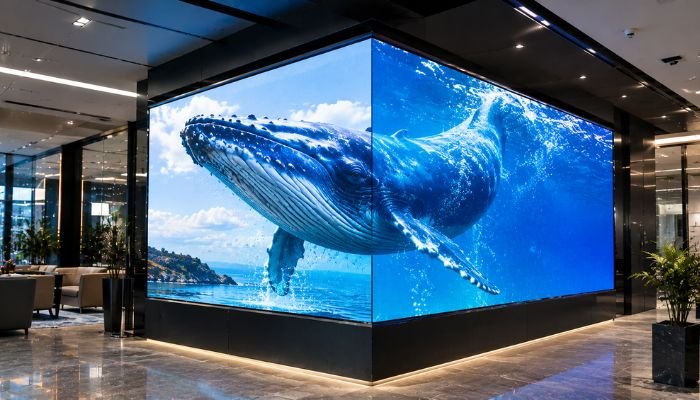
Picture a corner billboard where a giant wave seems to crash out of the building, or a sports car appears to drive off the screen toward you. People stop, film it, and share it. That reaction is the business case for naked-eye 3D LED displays. There are no glasses and no headsets, just two LED surfaces meeting at a corner and video rendered to fool the eye. Retail flagships and landmark billboards in Pakistan are starting to adopt the format. This guide covers how the illusion works, the hardware that makes it convincing, and what drives the price.
How Naked-Eye 3D Actually Works
Naked-eye 3D on an LED corner is an illusion of depth built on perspective, not true stereoscopy. Real stereoscopic 3D delivers a different image to each eye, which a standard LED screen cannot do. Instead, the effect combines two ingredients: a screen geometry of two faces meeting at 90 degrees, and anamorphic video, which is content rendered from one specific viewpoint so that, from there, perspective lines appear to extend beyond the physical surface.
Because the corner presents two planes at different angles, the brain reads the distorted image as a solid object projecting out of, or receding into, the corner. The catch is the sweet spot. The effect is strongest along the 45-degree axis that bisects the corner, and it flattens or looks stretched far to either side. That is why the format suits places where crowds view from one direction, and why phone cameras held at the sweet spot capture it so well.
Specs Architecture: 2D Billboard vs 3D Naked-Eye Screen
| Technical Feature | Standard 2D Billboard | SOPS Anamorphic 3D Naked-Eye Screen |
| Cabinet Joining Angle | 180° Flat Wall | 90° Seamless Mitered Corner / Smooth Curved Radius |
| Refresh Rate | 1,920 Hz | 3,840 Hz – 7,680 Hz (Zero Moiré for Mobile Photography) |
| Grayscale Processing | 14-Bit Standard | 16-Bit High Dynamic Range (Shadow Depth Rendering) |
| Optimal Viewing Sweet Spot | Front Center Only | 45° Intersection Axis (Simulated Holographic Depth) |
| Outdoor Brightness | 4,500 – 5,000 Nits | 6,000 – 7,500 Nits High-Contrast Diodes |
Values reflect high-specification configurations. Confirm exact figures on the datasheet of the model you choose.
Hardware Architecture
The 90-Degree Mitred Corner
The corner is the heart of the system. Cabinets on each face are built with 45-degree mitred edges, so when the two faces meet at 90 degrees the pixel grid continues around the corner with almost no gap. A visible seam, dark line, or uneven pixel spacing breaks the illusion at its most important point. Smooth curved-radius cabinets are an alternative for softer corners, and they suit organic shapes such as waves and smoke.
Both approaches demand millimetre-level mechanical accuracy and a rigid sub-frame, since small misalignments between faces show up as a step or colour shift along the edge. For this reason, display engineering and structural fabrication should be done by one team, not split between two suppliers.
Refresh Rate, Grayscale, and Brightness
Phones are the real audience, so refresh rate matters. A low rate produces scan lines and flicker when filmed. Panels running 3,840 Hz to 7,680 Hz stay clean on camera even at fast shutter speeds.
Grayscale depth matters as much. Shading gives a 3D object its volume, and 16-bit processing renders smooth shadow gradients where lower bit depth bands and flattens dark areas. Brightness completes the picture. Outdoor corners compete with sunlight, so 6,000 to 7,500 nits with high-contrast, black-face diodes keep the image punchy and the screen edges dark, which helps the object appear to float free of the frame.
Pixel Pitch and Viewing Distance
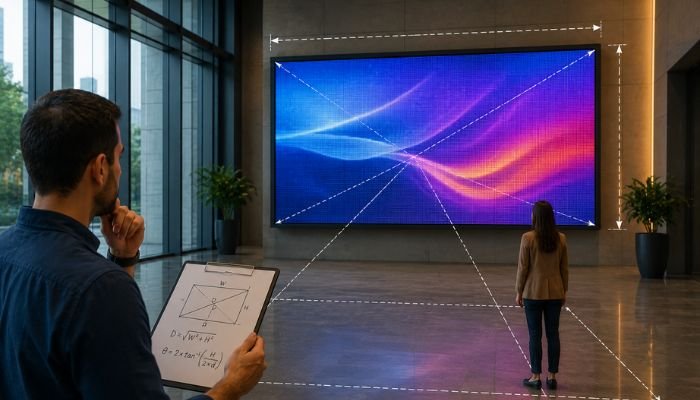
Choose pitch from the closest viewer. The minimum comfortable distance in metres is roughly the pitch in millimetres, and two to three times that is better. Indoor showroom corners, where viewers stand close, use fine pitches from P0.8 to P1.8. Outdoor landmark corners viewed from the street use larger pitches, selected by the real distance of the main audience. A P6 screen, for example, looks best from about 12 metres and beyond.
Anamorphic Content: Half of the Effect
Hardware alone does not produce 3D. The same corner can look spectacular or flat depending on the content. A sound workflow looks like this:
- Model the screen exactly. Both faces, their sizes, and the corner angle go into the 3D scene at true scale.
- Fix the camera at the sweet spot. The virtual camera sits where real viewers will stand, on the 45-degree axis.
- Render for the L-shaped canvas. Output matches the native pixel resolution of both faces, so nothing is rescaled.
- Test on site. Review the content on the real screen, and shoot it on a phone from the sweet spot.
Design choices matter too. Let objects cross the corner edge, because that is where depth reads best. Use a dark background so the screen boundaries vanish. Add shadows and strong contrast, keep motion smooth and not too fast, and avoid fine detail along the seam.
Siting a Corner Display
A naked-eye 3D billboard in Lahore, Karachi, Islamabad, or Rawalpindi works best on a building corner, mall frontage, or junction landmark with open space along the 45-degree axis, such as a plaza or wide pavement, where people can stop and look. Check the orientation against sunlight, and make sure the structure can carry the wind load of two large faces.
Consider traffic as well. A spectacular screen near a busy junction can distract drivers, so check local rules and place the sweet spot on the pedestrian side. Plan power and cooling for peak brightness, because two bright faces generate considerable heat in Pakistan’s summers.
Plan maintenance access too, since a mitred corner is hard to reach once the frame is complete. Front-serviceable modules and a service hatch near the corner prevent costly downtime. Finally, keep content fresh. A 3D corner earns attention through novelty, so budget for new animations for campaigns, seasons, and launches instead of looping one clip for months.
3D SMD Screen Price Factors
A 3D corner display costs more than a flat screen of the same area. The main drivers are:
- Pixel pitch, since finer pitch means more LEDs per square metre
- Total area of both faces and the corner geometry
- Custom mitred or curved cabinets, and the precision frame behind them
- Brightness, refresh rate, and 16-bit processing specification
- Controllers and video processors for the L-shaped canvas
- Custom anamorphic content, often priced per second of animation
- Power, cooling, permits, and installation access
Ask for a quotation that separates screen, structure, and content, so you can compare suppliers fairly.
About SOPS
Smart One Power Solutions (SOPS) delivers SOPS specialty LED displays focused on fine-pitch P0.8 to P1.8 setups and 3D architectural displays. It operates across Lahore, Karachi, Islamabad, and Rawalpindi, and its service portfolio covers turnkey structural fabrication and anamorphic LED engineering, so cabinet geometry, frame, and 3D content are designed as one system. Explore the SOPS home page or compare models under Our Products.
Frequently Asked Questions
What is a naked-eye 3D LED screen?
It is an LED display, usually built as a 90-degree corner or curved screen, that shows anamorphic video rendered for a specific viewpoint, so objects appear to project out of the screen without any glasses.
Do I need glasses to see the 3D effect?
No. The effect comes from perspective and screen geometry, so viewers see it with the naked eye, and it looks strongest from the sweet spot along the corner’s 45-degree axis.
Why does the effect need a corner or curved screen?
Two faces meeting at an angle give the eye two planes at different depths. Anamorphic content rendered across both faces reads as one solid object, which a flat screen cannot do as convincingly.
What refresh rate do 3D screens need for phone cameras?
A refresh rate of 3,840 Hz or higher keeps scan lines and flicker away when the screen is filmed, which matters because most viewers will record the effect on their phones.
What affects the price of a 3D SMD screen?
Price depends on pixel pitch, screen size, corner cabinet fabrication, brightness and processing specification, structural frame, custom 3D content creation, and installation access.
Get a Free Corner Site Survey and 3D Mockup
Every corner is different. We offer a free site survey and a 3D visual mockup showing how the effect will look from your sweet spot before you commit.
Call or WhatsApp: +92 308 4666059
Or send your location and dimensions through our Contact Us page.
Give your corner something worth stopping for.