SMD Screen for Textile Industry in Pakistan — Factory Floor Display Solutions
| TL;DR — Quick Answer An SMD Screen built for factory floor conditions gives Pakistan’s textile mills a way to display real-time production data, quality metrics, shift schedules, and safety announcements clearly across noisy, dusty, and lint-heavy production environments — something standard office displays simply aren’t built to survive. Textile factories need industrial-grade SMD screens with sealed or semi-sealed cabinets to resist dust and airborne fiber, high brightness for large open floor areas, and dependable power backup to stay running through continuous multi-shift operation. SMD Screens Pakistan installs these for textile mills nationwide, paired with power infrastructure from Smart One Power Solution. |
Introduction
Pakistan’s textile industry runs on tight margins, continuous shifts, and production targets that shift by the hour. For decades, factory floors relied on printed production boards, whiteboards updated by hand, and PA announcements to keep workers informed — methods that are slow to update, easy to overlook in a noisy environment, and prone to becoming outdated the moment a shift changes.
A growing number of textile mills across Faisalabad, Karachi, Lahore, and other manufacturing hubs are now installing SMD screens on the factory floor to solve exactly this problem. These large-format LED displays give production managers a way to show live output numbers, quality metrics, and safety information clearly, updated in real time, and visible from across a large industrial floor — something no printed board or handwritten whiteboard could ever match. This article looks at how SMD screens are being used specifically in textile manufacturing environments, what makes a screen genuinely suited to factory floor conditions, and what textile businesses in Pakistan should look for before investing in one.
What Is an SMD Screen, and Why Does It Suit Industrial Use?
An SMD screen is a large-format LED display built from modular panels or cabinets populated with Surface Mounted Device (SMD) LED chips. Compared to older LED display technology, SMD chips produce a smoother, more consistent image with strong brightness and wide viewing angles — qualities that matter significantly on a factory floor where a display might be viewed from dozens of meters away by workers moving between machines.
What makes an SMD screen particularly well suited to industrial environments, when properly specified, includes:
- Modular construction, allowing the display to be sized precisely for a specific factory wall, overhead mounting point, or control room
- High brightness output, keeping data legible even in large, brightly lit production halls
- Durability options, including sealed or semi-sealed cabinet variants that resist dust, lint, and airborne fiber common in textile production
- Real-time content flexibility, allowing production data to update continuously rather than relying on manual entry
That combination of ruggedness and real-time visibility is exactly what separates a factory floor SMD screen from a standard office or retail display, which typically isn’t built to survive the conditions inside a working textile mill.
The Unique Challenges of Textile Factory Environments
Before specifying any display for a textile production floor, it’s worth understanding what makes this environment genuinely different from an office, a retail store, or even most other industrial settings.
Airborne Lint and Fiber. Spinning, weaving, and processing operations release fine fiber particles into the air continuously, which can accumulate on ventilation openings and electronic components over time if a display isn’t properly sealed.
Dust and Debris. Beyond textile fiber specifically, general industrial dust from machinery and material handling adds to the challenge of keeping electronic components clean and functioning.
Continuous, Multi-Shift Operation. Many textile mills run production around the clock across multiple shifts, meaning a display isn’t switched on for a few hours a day — it’s expected to run reliably for extended, near-continuous periods.
Noise and Visual Competition. Factory floors are loud and visually busy, with machinery, moving materials, and constant activity competing for attention — a display needs to be genuinely bright and clear to stand out and communicate effectively in that environment.
Vibration. Depending on proximity to heavy machinery, a factory floor display may experience low-level vibration that a standard commercial mounting bracket isn’t necessarily designed to handle over years of continuous operation.
An SMD screen specified without accounting for these factors tends to underperform quickly — dimming, developing dead pixels from dust ingress, or simply failing well before its expected lifespan.
How Textile Mills Are Using SMD Screens on the Factory Floor
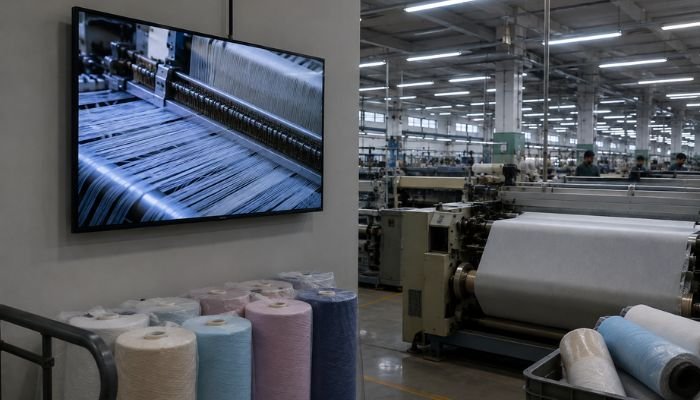
Real-Time Production Dashboards. SMD screens display live output numbers, machine efficiency data, and production targets, giving floor supervisors and workers immediate visibility into how a shift is performing against its goals.
Quality Control Metrics. Defect rates, rejection counts, and quality benchmarks can be displayed in real time, helping teams catch and address issues faster than they would with periodic manual reporting.
Andon-Style Alert Boards. Some textile facilities use SMD screens as part of an andon system, visually flagging line stoppages, maintenance needs, or bottlenecks so response teams can react quickly.
Shift and Schedule Information. Shift change times, staffing assignments, and production schedules can be displayed clearly across the floor, reducing the confusion that comes with relying on printed notices or word of mouth.
Safety Announcements and Compliance Reminders. Safety messaging, compliance reminders, and emergency information can be displayed prominently, reinforcing safety culture in a way that’s far more visible than a static poster on a wall.
Energy and Resource Monitoring. Some mills use factory floor SMD screens to display real-time energy consumption or resource usage data, supporting sustainability and cost-control initiatives on the production floor itself.
Specifying the Right SMD Screen for a Textile Factory Floor
Cabinet Sealing and Dust Resistance. This is arguably the most important factor for a textile environment specifically — cabinets need adequate sealing or filtered ventilation to prevent lint and dust from accumulating on internal components over time.
Brightness for Large, Open Spaces. Factory floors are typically large, well-lit spaces, and a display needs sufficient brightness to remain clearly legible from a meaningful distance, not just up close.
Mounting for Vibration Resistance. Structural mounting near active machinery should account for vibration, using a secure frame rather than a standard lightweight bracket meant for calmer office environments.
Data Integration Capability. For real-time production dashboards, the screen’s control system needs to integrate with the factory’s existing data sources — production counters, quality systems, or ERP software — rather than requiring constant manual updates.
Continuous Operation Rating. Given multi-shift, near-continuous use, the screen’s components should be rated for extended daily operation rather than standard commercial usage limits designed for shorter daily run times.
Why Power Reliability Is Especially Critical in Textile Facilities
Textile mills already understand power reliability better than most industries — a voltage fluctuation or outage doesn’t just risk turning off a display, it can disrupt entire production lines, damage sensitive machinery, and cause costly downtime. A factory floor SMD screen sits within that same electrical environment, and treating its power supply as an afterthought creates unnecessary risk to an investment meant to improve floor visibility and communication.
This is where Smart One Power Solution plays a direct role. Rather than leaving the display vulnerable to the same voltage fluctuations that threaten production machinery, building conditioned power and backup capability into the SMD screen installation protects the display from the same electrical risks the rest of the factory already has to manage — keeping production dashboards, safety alerts, and shift information visible and accurate even during grid instability.
How SMD Screens Pakistan Approaches Textile Factory Installations
SMD Screens Pakistan works with textile mills and manufacturing facilities across Pakistan to specify and install SMD screens genuinely built for factory floor conditions, rather than repurposing standard commercial displays.
Environment-Specific Specification. The team assesses dust and lint exposure, ambient lighting, viewing distance, and proximity to vibration sources before recommending the appropriate cabinet sealing, brightness, and mounting approach.
Industrial-Grade Installation. Mounting structures are engineered for the factory’s actual conditions, accounting for vibration and structural load rather than relying on standard commercial installation practices.
Data Integration Support. For facilities wanting real-time production dashboards, the installation includes configuring the display to pull data from existing production or quality systems rather than requiring manual updates.
Reliable Power Integration. Every factory floor installation can include conditioned power and backup support built with Smart One Power Solution, protecting the display from the same electrical risks already present in the facility.
Ongoing Maintenance Support. Given the demanding environment, ongoing cleaning guidance, component inspection, and troubleshooting support remain available well after installation.
The Installation Process, Step by Step
Step 1: Factory Floor Assessment
The team evaluates the specific production environment — dust and lint levels, ambient lighting, typical viewing distances, and proximity to machinery — to determine the right screen specification.
Step 2: Screen and Cabinet Specification
Based on the assessment, the appropriate sealing level, brightness, and cabinet construction are selected specifically for the facility’s conditions.
Step 3: Structural and Vibration-Resistant Mounting
A mounting structure suited to the factory’s physical conditions is installed, accounting for any vibration or structural considerations near active machinery.
Step 4: Data and Content Integration
Where real-time dashboards are required, the display is configured to pull data from the facility’s existing production, quality, or ERP systems.
Step 5: Power Integration and Commissioning
Power conditioning and backup capability are installed where needed, followed by full testing under actual factory floor conditions before final handover.
Maintenance Considerations for Factory Floor SMD Screens
- Schedule more frequent cleaning than a typical commercial installation, given continuous lint and dust exposure
- Inspect cabinet seals and ventilation points regularly to confirm dust ingress isn’t affecting internal components
- Monitor for any vibration-related mounting wear near active machinery and address it before it becomes a structural issue
- Test power backup systems periodically to confirm reliable operation during an actual grid disruption
- Keep spare panels or modules available given the more demanding operating conditions compared to office or retail environments
Cost Factors for Textile Factory SMD Screens
Pricing for a factory floor SMD screen in Pakistan depends on several considerations beyond a standard commercial installation:
- Cabinet sealing level — dust and lint-resistant construction typically costs more than standard indoor cabinets
- Screen size and brightness — larger, brighter panels for open factory floors increase cost accordingly
- Mounting complexity — vibration-resistant structural mounting near machinery adds engineering cost
- Data integration requirements — connecting the display to existing production or quality systems may involve additional setup
- Power backup infrastructure — conditioned supply and backup, such as systems built by Smart One Power Solution
- Maintenance and support plans — given the demanding environment, a more frequent maintenance schedule is often worthwhile
A transparent quotation should break these down individually so factory decision-makers understand exactly what they’re investing in.
Frequently Asked Questions
Can a standard commercial SMD screen be used on a textile factory floor?
It’s not recommended. Standard commercial displays typically lack the dust and lint resistance, brightness, and continuous-operation rating needed for a textile production environment, and tend to fail faster than a properly specified industrial-grade unit.
How does an SMD screen handle the dust and lint in a textile mill?
Properly specified factory floor SMD screens use sealed or semi-sealed cabinets designed to resist dust and fiber ingress, protecting internal components that would otherwise be exposed in a standard commercial unit.
Can an SMD screen display real-time production data from existing factory systems?
Yes, with proper integration, an SMD screen can pull live data from production counters, quality systems, or ERP software to display real-time dashboards rather than relying on manual updates.
Why does power backup matter so much for a textile factory display?
Textile facilities already face voltage fluctuations that can affect production machinery, and a factory floor display sits within that same electrical environment. Backup power, such as systems built by Smart One Power Solution, protects the display from the same risks.
How often does a factory floor SMD screen need maintenance?
Given continuous dust and lint exposure, factory floor screens generally need more frequent cleaning and inspection than a standard commercial installation to maintain performance and prevent component failure.
Conclusion
An SMD screen built specifically for factory floor conditions gives Pakistan’s textile mills a genuinely reliable way to communicate production data, quality metrics, and safety information across a demanding industrial environment that standard displays were never designed to survive. Getting it right means specifying proper dust and lint resistance, adequate brightness for open factory spaces, vibration-resistant mounting, and dependable power backup — exactly the approach SMD Screens Pakistan takes on every textile facility installation, supported by power infrastructure from Smart One Power Solution.
See related solutions: Outdoor SMD Screen projects and our full project portfolio.
| Planning an SMD Screen for Your Textile Factory Floor? SMD Screens Pakistan designs and installs industrial-grade SMD screens for textile mills and manufacturing facilities across Pakistan, built to handle dust, lint, and continuous multi-shift operation, with reliable power backup from Smart One Power Solution. Explore our Indoor SMD Screen solutions or contact our team today for a free site assessment and quotation. |