SMD Screen vs Projector for Conference Rooms: Which Display Is Best for Your Business in 2026?
| TL;DR — Quick Answer For most modern conference rooms, an SMD Screen vs Projector comparison favors the SMD screen — it delivers brighter, sharper images that stay visible under normal room lighting, needs far less ongoing maintenance, and holds its value better over a multi-year lifespan. A projector can still make sense for smaller budgets, occasional-use rooms, or spaces where a very large image is needed at a lower upfront cost. For boardrooms that run daily briefings, an SMD screen paired with a stable power setup from Smart One Power Solution is generally the more dependable long-term investment. |
Introduction
Every business fitting out a conference room eventually hits the same fork in the road: SMD screen or projector? Both technologies can put a large image in front of a room full of people, but they get there in very different ways, and the gap between them has widened significantly as SMD LED technology has matured. What used to be a simple budget decision is now a genuine trade-off between image quality, running cost, and how the room will actually be used day to day.
This article breaks down the SMD screen vs projector debate specifically for conference room use in 2026, covering brightness, image clarity, total cost of ownership, installation complexity, and maintenance demands. Whether you’re outfitting a single boardroom or planning AV upgrades across multiple offices, this comparison is built to help you make a decision based on how your room is actually lit and used — not just on sticker price.
Understanding the Two Technologies
Before comparing performance, it helps to understand what each technology actually is.
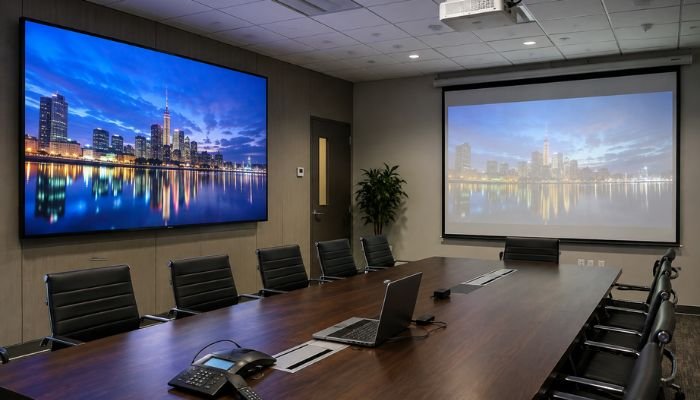
SMD Screens. An SMD (Surface Mounted Device) screen is a modular LED video wall built from LED panels or cabinets that produce their own light. There’s no lamp, no external light source, and no separate screen surface — the display itself is the image source, self-illuminating and seamless when properly installed.
Projectors. A projector uses a lamp or laser light source to cast an image onto a separate reflective screen or wall surface. The image quality depends heavily on both the projector’s brightness output and the screen material it’s projected onto, as well as how much ambient light is competing with that projected image.
That structural difference — self-illuminating display versus projected light onto a passive surface — is the root cause of nearly every practical difference between the two technologies in real-world use.
Brightness and Visibility Under Room Lighting
This is where the comparison usually gets decided fastest. Projectors are rated in lumens, and even a strong business projector can struggle to stay clearly visible in a room with normal overhead lighting or daylight coming through windows — which is exactly the kind of room most conference spaces actually are.
SMD screens, by contrast, are self-illuminating and typically deliver far higher effective brightness than a projected image in the same conditions. That means a conference room can stay properly lit for note-taking, video calls, and normal in-person interaction while the display remains sharp and legible — something a projector-based setup usually can’t match without dimming the room.
For any boardroom that hosts video calls, note-taking, or in-person discussion alongside the presentation, this single factor often settles the SMD screen vs projector decision on its own.
Image Quality and Viewing Experience
Beyond raw brightness, the two technologies differ in how the image actually looks up close and from different seats in the room.
Seamlessness. Projected images are a single continuous surface by nature, which sounds like an advantage — but modern SMD screens, when properly installed with fine pixel pitch, now deliver a similarly unified image without the soft focus or slight color drift that can appear at the edges of a projected image.
Contrast and Color. SMD panels typically produce deeper blacks and more vibrant color than a projected image, since each LED pixel generates its own light rather than relying on reflected light bouncing off a screen surface.
Viewing Angle. Projected images can lose brightness and contrast when viewed from a sharp angle at the side of the room. Quality SMD screens generally maintain consistent brightness and color across a much wider viewing angle, which matters in conference rooms with long tables and seating along both sides.
Close-Range Clarity. For rooms where people sit relatively close to the display, a fine-pitch SMD screen can render text and detailed charts with more consistent sharpness than a projected image, which can show visible pixelation or softness depending on projector resolution and throw distance.
Total Cost of Ownership
Upfront price often favors projectors, but total cost of ownership tells a more complete story over a multi-year period.
Upfront Cost. A projector and screen setup is typically less expensive to purchase initially than an SMD screen of a comparable size, which is why smaller budgets or occasional-use spaces often start here.
Lamp and Maintenance Costs. Traditional projector lamps degrade over time and need periodic replacement, an ongoing cost that adds up over the years. Laser projectors reduce this but don’t eliminate it entirely. SMD screens, once properly installed, generally require far less recurring replacement of core components.
Lifespan. A well-maintained SMD screen can operate reliably for many years of daily use with gradual, predictable brightness change, while projector lamps and even laser modules have a defined operational lifespan that eventually requires replacement or full unit upgrade.
Energy Use. Depending on brightness settings and room size, the ongoing power draw of each technology varies, but the more important factor for total reliability is power stability — a concern for both technologies in facilities that experience voltage fluctuations, which is where a proper backup power setup becomes relevant regardless of which display is chosen.
Installation and Room Requirements
The physical requirements of each technology shape what’s realistic for a given room.
SMD Screen Installation. Requires a wall-mounted structure and enough depth for the cabinet array, along with structured cabling for power and signal. Once installed, there’s no need to manage projector-to-screen alignment or throw distance.
Projector Installation. Requires careful planning of throw distance between the projector and screen, ceiling or wall mounting for the projector unit itself, and a separate screen surface — plus attention to keystone correction and focus, which can shift slightly over time and need occasional readjustment.
Room Depth and Layout. Rooms that are narrow or oddly shaped can make it difficult to achieve the correct projector throw distance for a large image, whereas an SMD screen’s size is determined by the wall-mounted panel array itself rather than distance to a separate screen.
Maintenance and Long-Term Reliability
Ongoing maintenance is often the most underestimated factor when comparing these two technologies.
SMD screens are modular by design — if an individual panel or module develops a fault, it can typically be serviced or replaced without dismantling the entire display, and the sealed nature of quality cabinets means less exposure to dust accumulation on delicate optical components.
Projectors require more hands-on upkeep: air filters need periodic cleaning to prevent overheating, lamps or laser modules eventually need replacement, and focus or keystone settings can drift and require readjustment, particularly in rooms where the unit isn’t in a completely fixed position.
For a conference room used daily, the lower maintenance burden of an SMD screen often becomes a meaningful factor in the total decision, not just a minor convenience.
Power Reliability: A Factor Both Technologies Share
Whichever display technology a business chooses, power stability affects how reliably it performs day to day. A conference room display that resets or shuts down mid-presentation due to a voltage dip undermines the investment regardless of whether it’s an SMD screen or a projector.
This is where working with a power specialist becomes relevant to the decision. Smart One Power Solution designs conditioned power and backup systems for AV installations, ensuring that whichever display technology a business selects, it continues operating cleanly through short outages and voltage fluctuations rather than interrupting an important meeting at the worst possible moment.
When a Projector Still Makes Sense
Despite the advantages of SMD screens, projectors remain a sensible choice in specific situations:
- Budget-constrained projects where the lower upfront cost of a projector and screen setup fits the available funding better
- Occasional-use rooms that host presentations only a few times a month, where the higher purchase cost of an SMD screen is harder to justify
- Very large image requirements in bigger halls where achieving an equivalent SMD screen size would significantly increase cost
- Temporary or portable setups, such as training rooms that need to be reconfigured frequently, where a projector’s flexibility has a genuine advantage
When an SMD Screen Is the Better Investment
An SMD screen tends to be the stronger choice in situations like:
- Daily-use boardrooms where brightness, image consistency, and low maintenance matter over years of regular use
- Naturally bright rooms with windows or overhead lighting that would wash out a projected image
- Video conferencing-heavy spaces where consistent, high-contrast visuals improve the experience for remote participants
- High-visibility corporate environments where visual quality reflects directly on the organization’s professional image
- Long-term cost planning, where lower maintenance and longer operational life offset the higher initial investment over several years
A Side-by-Side Comparison
| Factor | SMD Screen | Projector |
| Brightness in lit rooms | Excellent, self-illuminating | Reduced, needs dimming |
| Upfront cost | Higher | Lower |
| Long-term maintenance | Lower, modular repair | Higher, lamp/filter upkeep |
| Viewing angle | Wide, consistent | Narrower, angle-dependent |
| Installation complexity | Wall-mounted structure | Throw distance and alignment |
| Lifespan | Long, gradual degradation | Limited by lamp/laser life |
| Best for | Daily-use, bright rooms | Budget or occasional use |
Frequently Asked Questions
Is an SMD screen always better than a projector for a conference room?
Not always — it depends on budget, room lighting, and how often the room is used. SMD screens generally perform better in bright, daily-use rooms, while projectors can be more cost-effective for occasional use or very large image requirements.
Do SMD screens need less maintenance than projectors?
Generally, yes. SMD screens don’t have a lamp that needs periodic replacement, and modular cabinets allow individual panel servicing without affecting the rest of the display, whereas projectors need filter cleaning and eventual lamp or laser module replacement.
Why does room lighting matter so much in this comparison?
Projected images compete directly with ambient light in the room, so brighter rooms wash out projector images more easily. SMD screens generate their own light and stay clearly visible even in well-lit conference rooms.
Does an SMD screen or projector need backup power more?
Both benefit from stable power, since either technology can be disrupted by voltage fluctuations or outages. A conditioned power setup, such as those built by Smart One Power Solution, protects the investment regardless of which display technology is chosen.
Which option is more cost-effective over five years?
For a daily-use conference room, an SMD screen often works out more cost-effective over several years due to lower maintenance and longer operational life, even though the upfront cost is higher than a projector setup.
Conclusion
The SMD screen vs projector decision ultimately comes down to how a specific room is used, how much ambient light it deals with, and how the budget is structured — upfront cost versus long-term cost of ownership. For daily-use boardrooms with normal room lighting and frequent video conferencing, an SMD screen generally delivers a clearer, more reliable, and lower-maintenance experience over its operational life. For occasional-use spaces or tighter budgets, a well-specified projector setup can still do the job effectively. Whichever technology fits your business, pairing it with a stable power setup — like those designed by Smart One Power Solution — protects the investment from the kind of power interruptions that can undermine even the best display technology.
| Not Sure Which Display Is Right for Your Conference Room? SMD Screens Pakistan helps businesses assess room lighting, usage patterns, and budget to recommend the right display technology — SMD screen or projector — and installs it with proper power backup for reliable, long-term performance. Explore our Indoor SMD Screen solutions or contact our team today for a free site assessment and personalized recommendation. |