From Static to Smart: The Evolution of Digital Signage
Think about the last time you walked past a glowing LED screen at a shopping mall, a roadside digital billboard, or a bright display inside a corporate lobby. Chances are, you barely noticed it consciously — but your eyes went straight to it. That is not an accident. That is decades of evolution at work.
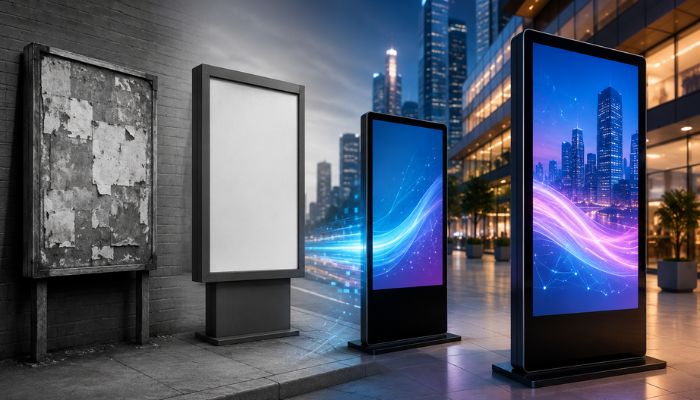
Digital signage has come a long way. From hand-painted wooden boards and printed vinyl banners to AI-powered interactive SMD screens that update in real time — the journey has been nothing short of remarkable. And Pakistan, once a late adopter of this technology, is now rapidly catching up, with businesses, government institutions, and educational organisations across the country embracing smart digital displays as a core part of their communication strategy.
At Smart One Power Solutions, we have been at the forefront of this transformation in Pakistan. We have seen firsthand how organisations that once relied on printed posters and static billboards are now running dynamic, full-colour SMD screens that communicate more effectively, look more professional, and ultimately cost less in the long run. This article traces that evolution — from static to smart — and explains why digital signage is no longer a luxury but a necessity for any forward-thinking organisation.
The Era of Static Signage: Where It All Began
For centuries, businesses communicated through static signs. Hand-painted wooden boards, carved stone inscriptions, cloth banners, and eventually printed vinyl — these were the tools of communication for shops, markets, governments, and institutions. They were simple, affordable, and effective for their time.
In the 20th century, printed signage became more sophisticated. Offset printing allowed for full-colour images. Backlit lightboxes made signs visible at night. Neon signs added a sense of energy and vibrancy to storefronts. By the time the 1990s arrived, large-format printing made billboard advertising a dominant medium for outdoor marketing.
But static signage had a fundamental limitation that no amount of creative design could overcome: once printed, it could not change. If your price changed, your event was cancelled, or your promotion ended — you needed to reprint. This meant ongoing costs, wasted materials, logistical delays, and an inability to respond quickly to events in the real world.
The Limitations That Pushed Change
Static signage was expensive to maintain at scale. Large retail chains with hundreds of outlets could not update their promotional material quickly — it required printing, shipping, and physically replacing displays across multiple locations. Event organisers had to commit to messaging weeks in advance. Outdoor advertisers were locked into fixed campaigns with no flexibility.
These pain points created the demand for something better. Something that could display multiple messages, update remotely, react to conditions, and deliver a richer visual experience. The answer came in the form of digital signage — and it has been evolving at an extraordinary pace ever since.
The First Wave: CRT Screens and Early Digital Displays
The first digital displays in commercial settings were CRT (Cathode Ray Tube) televisions — the same bulky units used in homes. In the 1980s and early 1990s, retailers and hospitality businesses began placing TVs in their spaces to loop promotional videos on VHS tapes. It was rudimentary, but it was a start.
The concept was simple: replace a static printed poster with a moving image. A department store could show a video of a product in use. A hotel lobby could display a looping welcome message. A fast food restaurant could show menu items as video clips.
The technology was limited — low resolution, heavy hardware, difficult to update — but it proved a critical concept: dynamic visual content captures more attention than static images. That single insight drove the entire digital signage revolution that followed.
The Transition to Flat-Panel Displays
By the early 2000s, flat-panel LCD and plasma screens began replacing CRT displays. They were thinner, brighter, and capable of much higher resolution. Content could now be delivered via DVDs, USB drives, or early network connections. Businesses could create slideshow-style presentations and display them on flat screens without needing a dedicated video player in the back.
This period marked the true birth of ‘digital signage’ as an industry category. Companies began developing dedicated media players, content management software, and commercial-grade display panels designed specifically for prolonged use in public environments. The concept of a ‘display network’ — where a single source could push content to many screens simultaneously — started to emerge.
The LED Revolution: Brightness, Scale and Outdoor Capability
While LCD screens worked well indoors, they struggled in outdoor environments. Sunlight washout — where bright ambient light makes a display nearly unreadable — was a major problem. Consumer-grade screens were simply not bright enough to compete with the sun, and they were not weatherproof enough to survive Pakistani summers, dust storms, or monsoon rain.
This is where LED (Light Emitting Diode) display technology changed the game entirely. LED displays could achieve brightness levels of 5,000 to 10,000 nits — compared to the 300–500 nits typical of indoor LCD panels — making them fully visible in direct sunlight. They were modular, meaning screens could be built in virtually any size. And they were durable, capable of operating continuously in extreme temperatures.
From DIP LEDs to SMD Technology
Early outdoor LED screens used DIP (Dual In-line Package) LEDs — the kind you might recognise from simple scoreboards or roadside scrolling text signs. DIP LEDs were robust and bright but had a relatively low resolution and a limited viewing angle. They were best suited for large-format billboards viewed from a significant distance.
The real breakthrough came with SMD (Surface Mounted Device) technology. SMD LEDs pack the red, green, and blue diodes into a single tiny component that sits flush on the surface of the display module. This allows for far higher pixel density, much wider viewing angles, better colour uniformity, and significantly lower power consumption compared to DIP displays.
SMD technology opened up an entirely new range of applications. Suddenly, high-resolution LED screens were practical not just for outdoor billboards but for indoor stages, corporate lobbies, retail environments, control rooms, auditoriums, mosques, schools, government buildings, and virtually any space where a vivid, large-format display was needed.
The Rise of Fine-Pitch Indoor LED
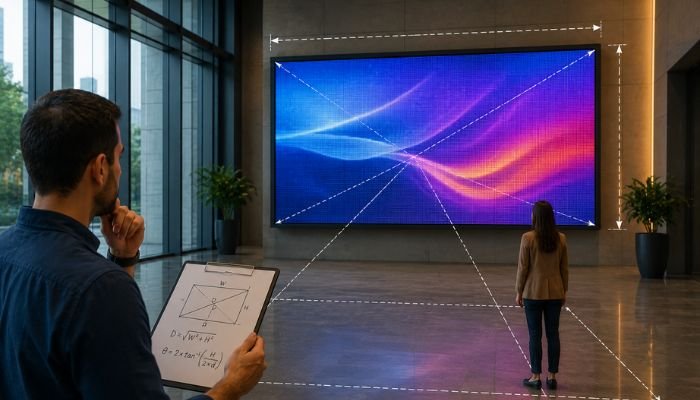
As SMD manufacturing became more precise, pixel pitches got smaller and smaller. Screens with pitches of P4, P3, P2.5, P2, and even below P1 became commercially available. These ‘fine pitch’ displays could be viewed from just a metre or two away while still delivering a perfectly smooth, high-definition image — effectively replacing large-format LCD video walls in boardrooms, broadcast studios, control centres, and command rooms.
In Pakistan, Smart One Power Solutions began offering fine-pitch indoor SMD screens precisely because we saw the demand growing from corporate clients, government agencies, and educational institutions that needed premium display quality for close-range viewing environments.
The Smart Era: Connected, Data-Driven, and Interactive Digital Signage
The latest chapter in the evolution of digital signage is not just about better screens — it is about smarter screens. Modern digital signage has evolved from a one-way broadcast medium into a dynamic, connected, data-driven communication platform. This is the era of ‘smart’ digital signage, and it is transforming how organisations communicate with their audiences.
Cloud-Based Content Management
Today’s digital signage systems are managed through cloud-based content management platforms. An organisation with screens in Karachi, Lahore, Islamabad, and Peshawar can update every single display simultaneously from a laptop or smartphone — anywhere in the world. Content can be scheduled, segmented by location, updated in real time, and even personalised based on the time of day or audience profile.
For businesses running promotional campaigns, this is transformative. Instead of printing and distributing new materials every week, a marketing team can update their screen network in minutes. A restaurant can change its menu board at breakfast, lunch, and dinner. A retailer can push flash sale content instantly. A university can display emergency notices across its entire campus in seconds.
AI, Analytics and Audience Intelligence
The most advanced digital signage systems now integrate artificial intelligence and audience analytics. Cameras and sensors can detect the number of people near a screen, estimate their age range and gender, and even track how long people look at specific content. This data feeds into AI algorithms that automatically optimise what is displayed — showing content that is most relevant to the current audience.
While this level of sophistication is still emerging in Pakistan’s market, it is already standard in smart retail environments, airports, and transit systems in more mature markets. As the technology becomes more affordable, Smart One Power Solutions anticipates strong demand for AI-integrated display solutions in Pakistan within the next few years.
Interactive Touchscreen Displays and Kiosks
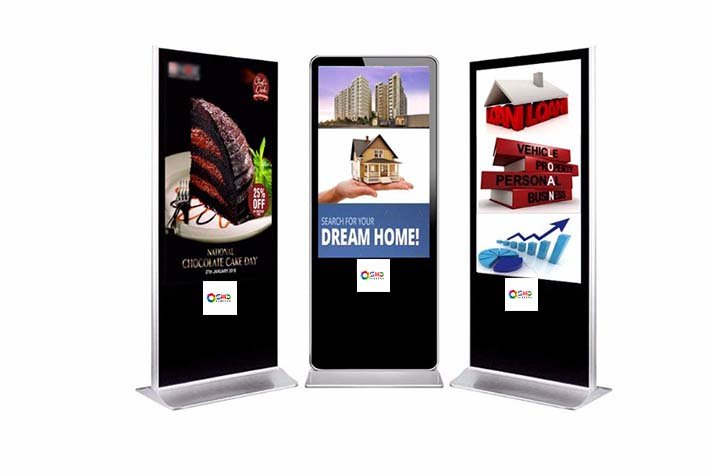
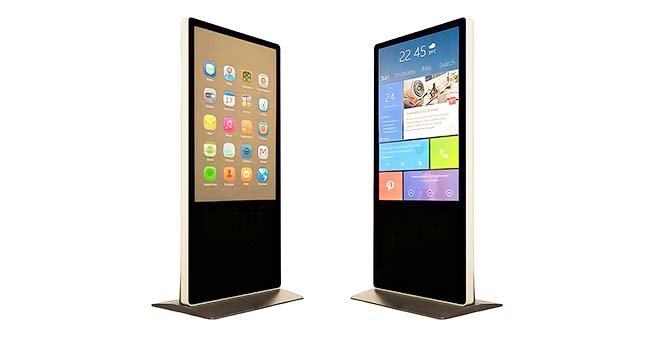
Digital signage is no longer just something you watch — it is increasingly something you interact with. Touchscreen LED and LCD kiosks allow customers to browse products, check in for appointments, access information, navigate buildings, and place orders — all without human assistance. This kind of interactivity is already transforming retail, hospitality, healthcare, and government service environments globally.
In Pakistan, self-service kiosks are increasingly common in banks, telecom outlets, and large retail chains. As the cost of touchscreen technology continues to fall, adoption across smaller businesses and public sector institutions will accelerate. Smart One Power Solutions offers both standard SMD screens and bespoke interactive display solutions for clients who are ready to take their customer experience to the next level.
Transparent LED Displays: The Future Is Literally See-Through
One of the most visually stunning developments in modern LED display technology is the transparent LED screen. These displays allow viewers to see through the screen while simultaneously displaying vivid, bright content — making them ideal for shop windows, glass partitions, architectural features, and exhibition stands.
Transparent LED screens achieve transparency levels of 70–95%, meaning the natural light and view behind the screen are largely preserved. Smart One Power Solutions currently offers transparent LED display solutions in Pakistan for retail, corporate, and architectural applications — a technology that just a few years ago was only seen at international trade shows and flagship brand stores.
Digital Signage in Pakistan: A Market Rapidly Coming of Age
Pakistan’s digital signage market has grown dramatically in recent years. What was once a technology exclusive to multinational corporations and five-star hotels is now being adopted by schools, mosques, hospitals, government offices, SMEs, and mid-sized retailers across the country.
Several factors are driving this acceleration. First, the cost of SMD and LED display technology has fallen significantly, making quality screens accessible at price points that make business sense for a much wider range of organisations. Second, awareness has grown — more Pakistani business owners understand what digital signage is and the value it delivers. Third, infrastructure has improved, with reliable broadband and mobile internet enabling cloud-managed screen networks to function effectively.
Key Sectors Driving Adoption in Pakistan
- Education: Universities, schools, and coaching centres using LED walls for lectures, events, and campus communication.
- Retail: Shopping malls, supermarkets, and fashion outlets deploying indoor SMD screens for promotions and wayfinding.
- Corporate: Offices and boardrooms upgrading to fine-pitch LED video walls for presentations and executive meetings.
- Government & Defence: Public institutions using outdoor and indoor SMD screens for information, ceremony displays, and security briefings.
- Hospitality: Hotels and restaurants displaying menus, promotions, and guest information on vibrant LED screens.
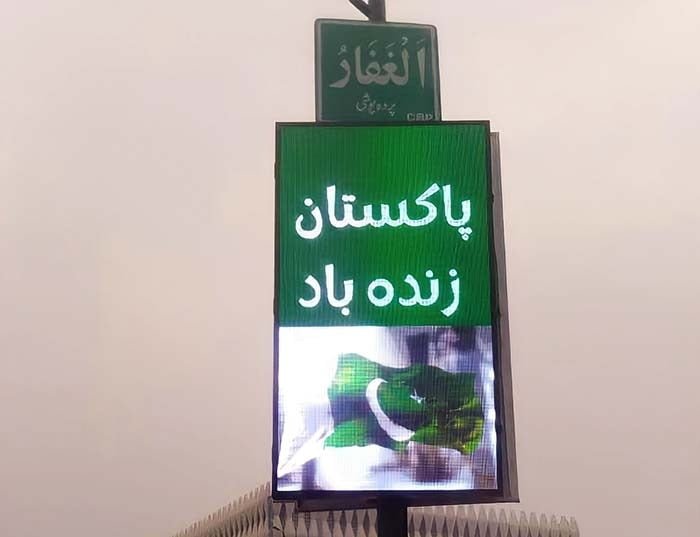
- Outdoor Advertising: Businesses and media companies replacing static billboards with high-brightness outdoor LED screens.
- Religious Institutions: Mosques and Islamic centres using LED displays for prayer times, event announcements, and Quranic content.
- Healthcare: Hospitals and clinics using digital signage for patient information, wayfinding, and health education.
Why Smart Digital Signage Outperforms Static Every Single Time
If you are still relying on printed signage, here is a straightforward, honest comparison of what you are missing.
Flexibility and Real-Time Updates
A static sign says one thing, forever — until you replace it. A smart SMD screen can display hundreds of different messages, scheduled precisely, updated instantly from anywhere. For any organisation that communicates multiple types of information to different audiences at different times, this flexibility alone justifies the investment.
Visual Impact and Attention
Studies consistently show that dynamic digital content attracts significantly more attention than static printed material. Bright, moving, full-colour content is processed faster by the human brain and retained longer. In a competitive environment — a busy shopping street, a crowded mall, a corporate reception — a vivid SMD screen simply cannot be ignored.
Long-Term Cost Efficiency
The upfront cost of a quality SMD screen is higher than a printed banner. But once you factor in the recurring costs of reprinting, transportation, installation, and waste disposal of static signage — plus the ongoing ability to change your content at zero marginal cost — digital signage delivers a substantially better return on investment over three to five years.
Sustainability
Every time a printed banner is replaced, material goes to waste. Modern LED screens are engineered for 100,000+ hours of operation, consuming significantly less energy than older display technologies. For organisations with environmental commitments, switching from printed to digital signage is a meaningful step toward reducing waste and carbon footprint.
How Smart One Power Solutions Is Leading Pakistan’s Digital Signage Revolution
Smart One Power Solutions is not just a supplier of screens. We are a full-service digital display solutions partner. From the initial consultation and site survey to custom design, professional installation, commissioning, staff training, and ongoing after-sales support — we handle every aspect of your digital signage project.
Our product range covers the full spectrum of modern display technology — indoor fine-pitch SMD screens, high-brightness outdoor LED displays, transparent LED panels, digital billboards, video walls, conference room displays, mosque displays, and custom-engineered solutions for unique spaces and requirements. We serve clients in Lahore, Karachi, Islamabad, Rawalpindi, Faisalabad, Sargodha, Multan, Peshawar, and across Pakistan.
Whether you are a startup looking for your first indoor screen, a government agency upgrading your outdoor communications, or a national retail brand building a country-wide screen network — Smart One Power Solutions has the technology, the team, and the track record to deliver.
Conclusion: The Evolution Is Ongoing — Are You Keeping Up?
The journey from static signage to smart digital displays is one of the most significant communication revolutions of the modern era. It is a journey driven by technology, fuelled by business need, and accelerated by the falling cost of high-quality display solutions.
Pakistan is at an exciting inflection point. Digital signage is no longer the preserve of multinational corporations and luxury brands. It is accessible, practical, and increasingly essential for any organisation that wants to communicate effectively, look professional, and stay ahead of the competition.
The question is no longer whether you should make the switch from static to smart. The question is how soon you can afford not to. Static signs are quickly becoming the fax machines of visual communication — functional but outdated, destined to be replaced by something better.
Smart One Power Solutions is here to make your transition seamless, affordable, and built to last. Get in touch today and let us show you what the future of digital signage looks like — because the future is already here.
Ready to Go Smart? Get a Free Quote Today!
Smart One Power Solutions | www.smdscreens.com.pk
Indoor & Outdoor SMD Screens | Digital Signage | LED Walls | Pakistan Nationwide
☎ +92-42-35929400 | ☎ +92-308-4666059 | ✉ info@smdscreens.com.pk