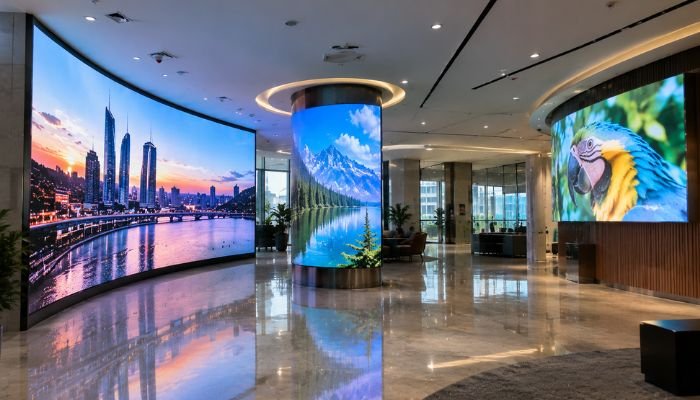
Curved Concave & Convex LED Video Walls in Pakistan: Commercial Architectural Display Guide
| Quick Answer Curved LED video walls in Pakistan utilize flexible silicone PCB modules and precision angled die-cast aluminum cabinets to construct seamless concave (inward-curving immersive theaters) and convex (outward-curving corner architectural wraps) displays. Smart One Power Solutions (SOPS) engineers custom-radius curved fine-pitch video walls (P1.2 to P2.5) delivering 160-degree panoramic viewing angles, zero bezels, and 3840Hz refresh rates for corporate lobbies and experience centers. |
Buildings are rarely flat, and the best rooms in them are never flat either. Reception atriums sweep in arcs, lobbies turn corners, and experience centres try to surround visitors rather than face them. A flat video wall in such a space always looks like an afterthought. A curved LED screen in Pakistan follows the architecture instead, creating a single continuous picture that bends with the room. This guide explains how concave and convex walls work, where they succeed, and what to plan before you order one.
Concave vs Convex: What Is the Difference?
The terms describe the direction of the curve. A concave wall curves inward, so its ends come toward the viewer and wrap around them. It suits theatres, control rooms and immersive showrooms, where the goal is to surround the audience. A convex wall curves outward, like the outside of a column or a building corner. It suits lobbies, retail fronts and architectural wraps seen from many directions.
Both rely on the same principle: modular cabinets set at precise angles so every joint closes into a smooth arc. For related formats, see our video walls page and our guide to cylinder and column LED screens.
Flat Display vs SOPS Curved LED Wall
The table below shows why a curved LED screen in Pakistan is engineered differently from a standard flat wall.
| Engineering Metric | Standard Flat LED Video Wall | SOPS Engineered Curved LED Display |
| Module Structure | Rigid Standard Fiberglass PCB | Flexible High-Elasticity Silicone Composite PCB |
| Viewing Immersion Field | Planar 120° Effective Cone | Immersive 160° Panoramic Peripheral Engagement |
| Cabinet Angle Adjustment | Fixed 180° Flat Locks | Precision Dial Curvature Locks (-15° Concave to +15° Convex) |
| Visual Seams at Curves | Noticeable Segmented Miter Gaps | 100% Seamless Continuous Arc with CNC Alignment Pins |
| Application Architecture | Standard Flat Walls | Corporate Experience Centers, Wave Screens & Cylinders |
Two rows deserve attention. The seam row explains visual quality: when flat cabinets are forced around a curve, thin wedge-shaped gaps appear and break the picture. The angle adjustment row explains flexibility: dial locks let engineers fine-tune the arc on site instead of relying on fixed factory angles.
Concave LED Display in Lahore: Theatres and Experience Centres
A concave LED display in Lahore is often chosen for spaces where the screen must feel like an environment. Brand experience centres, showrooms, auditorium stages, command rooms and training suites benefit when the picture wraps toward the audience, because visitors at the edges see the image face-on instead of at a sharp angle.
The 160° panoramic engagement in the matrix is the commercial payoff: more people see the content properly, and they stay longer. If your project involves stage backdrops, also read about our auditorium SMD screens.
Convex SMD Screen in Karachi: Corners, Lobbies and Frontages
A convex SMD screen in Karachi works where the display must be visible from several sides: hotel lobby columns, bank branches, mall entrances and corporate headquarters. A convex wall can turn a building corner without a hard break, which makes the architecture feel designed around the screen rather than interrupted by it.
Coastal humidity and heavy air-conditioning cycles place extra stress on electronics. Good cabinet sealing, ventilation planning and quality power supplies protect long-term reliability, so share your site conditions with us early through the contact page.
Seamless Curved Video Wall in Islamabad: Corporate Lobbies
A seamless curved video wall in Islamabad often serves headquarters reception areas, conference centres, hospitality venues and showrooms where first impressions matter. Here the wall is usually viewed at close range, which is why fine pitch matters. At P1.2 to P2.5, individual LEDs vanish at normal visitor distances, leaving a smooth image that looks like printed light rather than a grid of dots.
How a Curved LED Screen Works
Curved walls combine three engineering ideas:
- Flexible silicone composite PCB modules, which bend without cracking and tolerate repeated assembly.
- Precision die-cast aluminium cabinets, with angled edges so adjacent cabinets close cleanly along the curve.
- CNC alignment pins and dial curvature locks, which hold every joint at the exact angle and keep the arc continuous.
Zero-bezel construction removes visible frames, and a 3,840Hz refresh rate keeps the picture steady when filmed by phones and broadcast cameras, which matters in lobbies where visitors constantly record content.
Service access deserves attention at the design stage. A curved wall should allow a technician to reach and replace a faulty module without dismantling neighbouring cabinets, and a few spare modules from the same production batch keep colour consistent after any repair.
Planning the Radius
Every curved LED screen project begins with geometry. The arc length of a curved wall equals its radius multiplied by the angle in radians. For example, a 90° concave wall with a 3 metre radius spans about 4.7 metres along the curve. Engineers then divide that arc into cabinets and set each joint angle to close the curve exactly. Ceiling height, floor space, viewing distance and sight lines all influence the final radius, so a site survey and a 3D layout come before any fabrication.
Designing Content for a Curved LED Screen
- Pre-visualise. Preview artwork on a 3D model of the curve before final production.
- Respect the edges. Keep critical text away from extreme angles where it reads poorly.
- Use continuous motion. Flowing graphics and panoramic video show off a curve better than static slides.
- Match brightness to the room. Indoor lobbies need comfortable levels, not outdoor intensity.
Pair a curved wall with digital signage elsewhere in the building so the whole space shares one visual language. For another specialty format, see our interactive LED floor screens guide.
From Survey to Commissioning
A curved wall is delivered in stages, and skipping any stage shows in the final picture:
- Survey and 3D layout. Engineers measure the space, test sight lines and model the arc.
- Frame fabrication. A custom structure holds each cabinet at its planned angle.
- Cabinet assembly. Alignment pins and curvature locks close each joint along the arc.
- Colour and brightness are matched across every module so the curve looks uniform.
- Staff receive training on content playback, brightness control and basic care.
Flexible LED Panel Price Factors
A reliable quotation needs project details because flexible LED panel price factors vary widely:
- Pixel pitch, from P1.2 to P2.5, and total area.
- Radius complexity and number of curved sections.
- Cabinet and frame fabrication.
- Controller, processor and content system.
- Installation conditions, access and timeline.
- Training, service and warranty support.
Why Choose SOPS Curved LED Displays
SOPS curved LED displays are built by Smart One Power Solutions, a team focused on fine-pitch and architectural video walls. Its custom radii engineering covers concave and convex LED displays for Lahore, Karachi and Islamabad, and its SOPS display series includes flexible module installations from P1.2 to P2.5 for commercial spaces. Founded in 2005, the company works from survey to commissioning and after-sales support. Browse completed work on our Our Projects page, read the blog, or learn about us.
Frequently Asked Questions
What is the difference between concave and convex LED walls?
A concave wall curves inward to surround viewers, while a convex wall curves outward to wrap around columns or corners.
Which pixel pitch suits a curved video wall?
SOPS curved fine-pitch walls use P1.2 to P2.5, suitable for close viewing in lobbies and experience centres.
Will there be visible seams along the curve?
No. Precision cabinets, CNC alignment pins and dial curvature locks create a continuous arc without wedge gaps.
Can the curve be customised for my room?
Yes. SOPS engineers custom-radius walls after a survey and 3D layout of the space.
| Planning a Curved LED Screen in Pakistan? Share your room dimensions, desired radius and viewing distance with the SOPS team. We will propose a layout, pitch and structure, then send a transparent quotation. • Call: +92 42 35929400 | +92 308 4666059 • Email: info@smdscreens.com.pk • Get started: Request a free quote | Explore video walls • Lahore office: 658 Block B, Faisal Town, Lahore |