Indoor SMD Screens vs Commercial TVs: Which Display Is Better for Your Business in 2026?
| TL;DR — Quick Answer Indoor SMD screens generally outperform commercial TVs for businesses that need a large, seamless, high-brightness display — think lobbies, reception areas, retail storefronts, and control rooms — while commercial TVs remain the more practical choice for smaller spaces, single-screen setups, and tighter budgets. SMD screens scale to virtually any size without image degradation, run brighter and more consistently over years of daily use, and hold up better in commercial environments with heavy foot traffic. Pairing either with reliable power backup from Smart One Power Solution protects the long-term investment. |
Introduction
Not long ago, the choice for indoor business displays was straightforward — buy a commercial-grade TV, mount it, and move on. That’s no longer the only option. As Indoor SMD screens technology has become more accessible in price and easier to install, businesses across retail, hospitality, corporate, and institutional sectors are increasingly weighing SMD screens against commercial TVs before committing to a display strategy.
This comparison breaks down where each technology genuinely excels, where the other one falls short, and how to think about the decision for your specific space in 2026 — whether that’s a hotel lobby, a bank branch, a retail storefront, or a corporate reception area. The goal here isn’t to declare one technology universally superior, but to help you match the right display to the right room.
What Sets These Two Technologies Apart
Before comparing performance, it’s worth understanding the basic difference in how each display actually works.
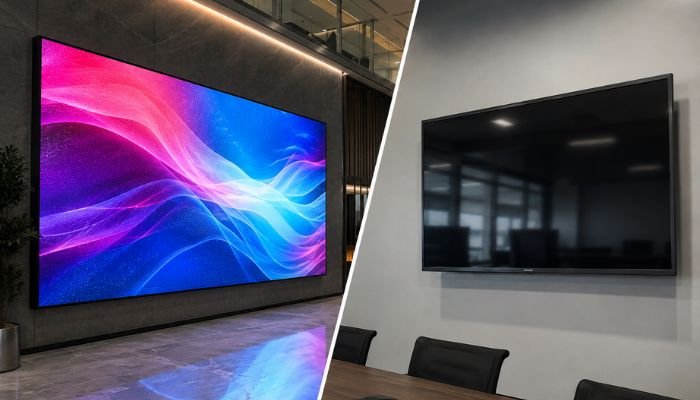
Commercial TVs. These are large-format flat-panel displays — typically LED-backlit LCD panels — built and rated for extended commercial use rather than casual home viewing. They come in fixed sizes, usually topping out in the 85 to 100 inch range for most commercially available models, with a single continuous panel and screen bezel.
Indoor SMD Screens. These are modular LED video walls built from individual LED panels or cabinets, each populated with Surface Mounted Device LED chips. Because the display is assembled from multiple modules, it can be built to virtually any size or aspect ratio, and when properly installed, produces a seamless image across the entire wall.
That structural difference — a single fixed panel versus a modular, scalable array — is the source of nearly every practical distinction between the two options.
Screen Size and Scalability
This is often the deciding factor before any other comparison even matters.
Commercial TVs are limited by manufacturing constraints to a fixed maximum size, generally topping out well short of what a large lobby wall or expansive retail storefront might call for. Beyond a certain size, commercial TVs also become significantly more expensive and harder to source, ship, and mount safely.
Indoor SMD screens have no such ceiling. Because they’re built from individual cabinets assembled together, a business can specify a display sized precisely to the available wall space — whether that’s a modest reception area or an entire feature wall spanning several meters — without the image quality dropping as the size increases.
For any business that needs a display larger than a single commercial TV can realistically offer, this factor alone often settles the comparison.
Brightness, Image Quality, and Viewing Distance
Brightness. Indoor SMD screens are self-illuminating LED displays and typically produce more consistent brightness across the entire surface than a backlit LCD panel, particularly at larger sizes where a commercial TV’s backlighting can show slight unevenness.
Contrast and Color. Both technologies can deliver strong image quality, but SMD screens — especially fine-pitch indoor models — tend to produce deeper contrast since each LED pixel generates its own light rather than relying on a backlight passing through a liquid crystal layer.
Seamlessness at Scale. A single commercial TV has no visible seam, which is a genuine advantage at smaller sizes. But once a business needs a display wider than one TV panel, multiple TVs bolted together introduce visible bezel lines — something a properly installed SMD screens avoids entirely, regardless of total size.
Viewing Distance Considerations. Indoor SMD screens are available in a range of pixel pitches, and selecting the right one for the room’s typical viewing distance is important — a screen viewed up close needs a finer pitch than one viewed from across a large lobby. Commercial TVs, with their fixed native resolution, don’t require this same pitch consideration, which simplifies selection for smaller, closer-viewing setups.
Durability and Commercial-Grade Reliability
Businesses run displays far longer and harder than a typical home TV ever experiences, and this is where the gap between the two technologies becomes more pronounced over time.
Operating Hours. Commercial TVs are rated for longer daily run times than consumer models, but most still carry recommended usage limits per day. Indoor SMD screens, built specifically for continuous commercial operation, are generally designed to run for extended hours daily without the same operational constraints.
Physical Durability. In high-traffic commercial environments — retail floors, hotel lobbies, transit areas — an SMD screen’s modular cabinet construction tends to hold up well against vibration, dust, and general wear, while a large single-panel TV can be more vulnerable to a single point of failure affecting the entire display.
Repair and Serviceability. If an individual section of an SMD screens develops a fault, a single module can often be serviced or replaced without affecting the rest of the display. A commercial TV with a fault typically means replacing or repairing the entire unit, since there’s no modular component to isolate.
Burn-In and Image Retention. Static content displayed for long periods can cause image retention on some panel types. Indoor SMD screens are generally more resistant to this than certain LCD panel technologies, which matters for businesses displaying fixed branding or static information for extended stretches.
Cost Comparison: Upfront vs Long-Term
Upfront Cost. For smaller display sizes, a commercial TV is typically less expensive to purchase than an equivalent-sized SMD screens, making it the more accessible option for single-screen, smaller-space installations.
Cost at Scale. As display size increases, the cost gap narrows and can even reverse — a very large commercial TV setup (multiple panels bolted together) can end up costing more than an equivalently sized SMD screens, while still leaving visible seams the SMD option avoids.
Installation Complexity. Commercial TVs generally mount more simply for smaller installations, while SMD screens require a structural mounting frame and more involved cabling — an upfront cost difference that narrows as project scale increases.
Long-Term Operating Cost. SMD screens built for commercial use tend to offer longer operational lifespans with gradual, predictable brightness degradation, while commercial TVs have a defined panel lifespan and may need full replacement sooner under heavy daily use.
Where Commercial TVs Still Make Sense
Despite the advantages of Indoor SMD screens at scale, commercial TVs remain the more sensible choice in several situations:
- Smaller spaces where a single screen in the 55 to 85 inch range comfortably covers the display need
- Budget-conscious single-screen projects, where the lower upfront cost of a commercial TV fits the available budget
- Quick, simple installations where mounting a single panel is preferable to a structural SMD frame and cabling setup
- Rooms viewed primarily up close, such as small meeting rooms, where a high-resolution TV panel already delivers excellent clarity at that distance
- Frequently relocated displays, where a single lightweight panel is easier to move between locations than a fixed SMD installation
Where Indoor SMD Screens Are the Stronger Choice
Indoor SMD screens tend to be the better investment in situations like:
- Large lobby, reception, or feature walls where a display larger than a single commercial TV panel is needed
- High-traffic retail and hospitality environments where durability and continuous operation matter over years of daily use
- Control rooms and command centers where a seamless, scalable video wall supports multiple data feeds or camera views
- Branding-focused spaces where a business wants a striking, large-format visual statement rather than a standard TV panel
- Long operating-hour environments, where the extended commercial-grade lifespan of SMD technology offsets the higher upfront investment over time
The Power Reliability Factor
Whichever display technology a business chooses, consistent power matters. A large-format display that resets, flickers, or shuts down due to a voltage dip undermines the professional impression it’s meant to create — whether it’s a commercial TV in a boardroom or an SMD screens spanning a lobby wall.
This is where Smart One Power Solution plays a role in the decision. Rather than treating power as an afterthought, building conditioned power and backup capability into the installation — for either technology — protects the investment from Pakistan’s variable grid conditions and keeps the display running reliably through short outages, rather than leaving a business with a dark screen at the worst possible moment.
A Side-by-Side Comparison
| Factor | Indoor SMD Screens | Commercial TV |
| Maximum size | Virtually unlimited, modular | Fixed panel size limit |
| Seamlessness at large sizes | Fully seamless | Visible bezels if combined |
| Upfront cost (small sizes) | Higher | Lower |
| Upfront cost (large sizes) | Often lower per sq. ft. | Higher, multiple panels needed |
| Durability for heavy daily use | Built for continuous operation | Usage limits typical |
| Repair approach | Modular, section-level | Full panel replacement |
| Best for | Large walls, high-traffic areas | Smaller rooms, single screens |
Frequently Asked Questions
Are Indoor SMD screens always more expensive than commercial TVs?
Not necessarily. For smaller sizes, commercial TVs are usually cheaper upfront, but as display size increases, SMD screens can become more cost-effective per square foot while also avoiding the visible seams of multiple combined TV panels.
Which option is better for a small meeting room?
For a room where the display is viewed from a short distance and doesn’t need to be especially large, a commercial TV is often the simpler, more cost-effective choice.
Do Indoor SMD screens last longer than commercial TVs in commercial use?
Generally, yes. SMD screens are built for continuous commercial operation with gradual, predictable brightness degradation, while commercial TVs typically carry recommended daily usage limits and a defined panel lifespan.
Can a commercial TV be used for a large lobby or feature wall?
It’s possible using multiple combined panels, but this introduces visible bezel lines between screens — something a properly installed Indoor SMD screens avoids entirely at any size.
Does power backup matter for both display types?
Yes. Both commercial TVs and Indoor SMD screens benefit from stable, conditioned power. Solutions like those built by Smart One Power Solution help protect either display type from voltage fluctuations and short outages.
Conclusion
The Indoor SMD screens versus commercial TVs decision isn’t about one technology being universally better — it’s about matching the display to the room, the budget, and how heavily it will be used. For large lobbies, high-traffic retail environments, and spaces that need a genuinely large-format, seamless visual statement, Indoor SMD screens generally deliver stronger long-term value despite a higher initial investment. For smaller rooms, tighter budgets, and simpler single-screen needs, a commercial TV remains a practical and cost-effective choice. Whichever technology fits your business, pairing it with reliable, conditioned power — like the systems built by Smart One Power Solution — protects the investment from the kind of interruptions that undermine even the best display technology.
| Not Sure Which Display Fits Your Business? SMD Screens Pakistan helps businesses assess room size, budget, and usage patterns to recommend the right display technology — Indoor SMD screens or commercial TV — and installs it with proper power backup for reliable, long-term performance. Explore our Indoor SMD Screens solutions or contact our team today for a free site assessment and personalized recommendation. |